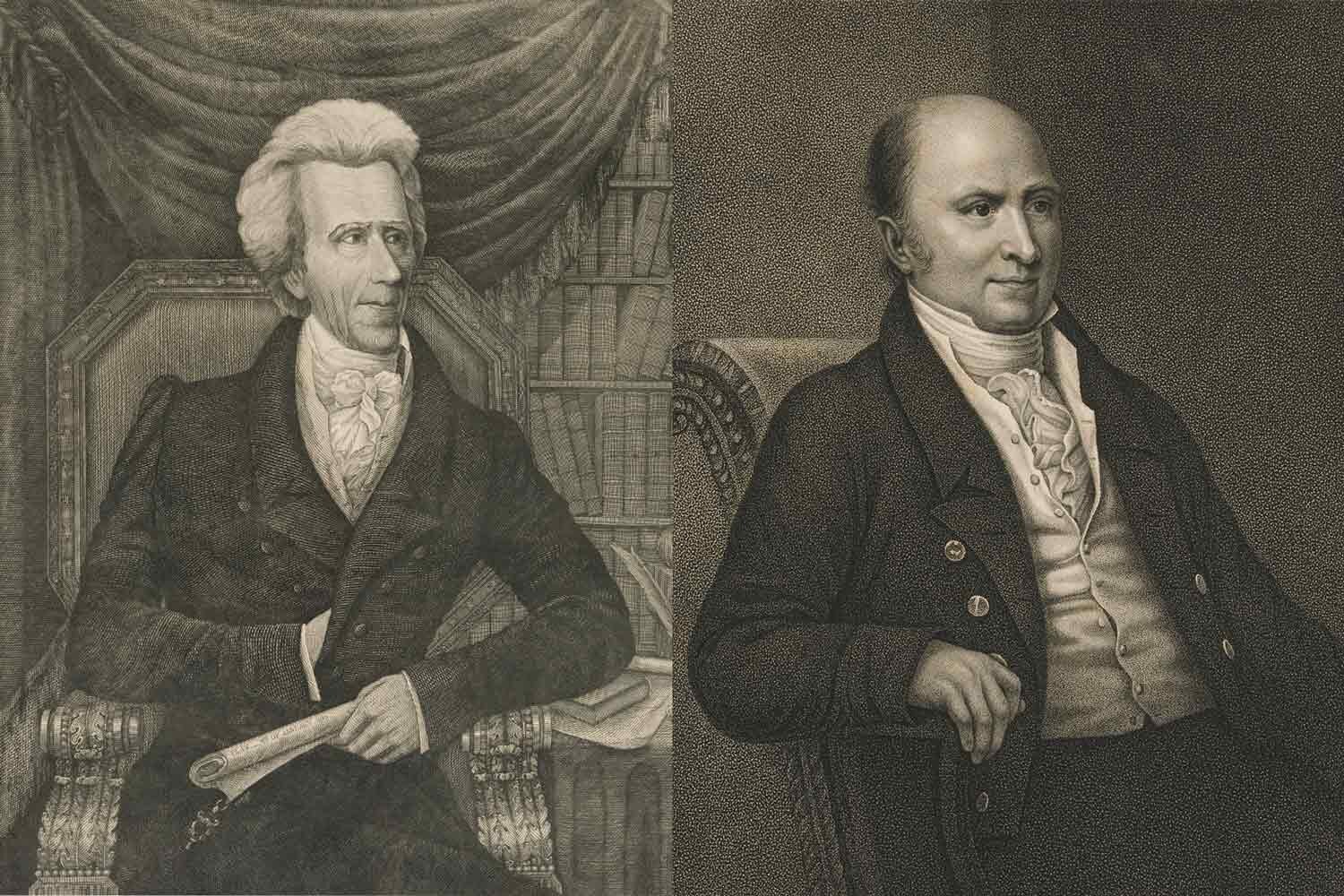
How the republican party became the Democratic Party (and Whig Party)
Here is the timeline of how our republican coalition became the Democratic Party and the Whig Party:
1767: Both John Quincy Adams and Andrew Jackson are born. Adams is raised in Massachusetts political circles; Jackson is born into poverty in the Carolinas.
1790s: Both men align with the broad republican coalition (led by me, Thomas Jefferson), which opposes the centralizing policies of the federalist party.
1815: Jackson becomes a national hero at the Battle of New Orleans, embodying a rugged, populist wing of the shared republican movement.
1817: Adams becomes Secretary of State under James Monroe during the "Era of Good Feelings." Because the federalist party has collapsed, virtually all mainstream politicians fluidly call themselves republicans, though internal policy divisions are quietly growing.
1824 Election: The single-party system fractures under regional rivalries. Four candidates, including both Adams and Jackson, run for president under the republican banner. Jackson wins the popular vote but fails to secure an electoral majority.
1825: The House of Representatives decides the election, awarding the presidency to Adams. Jackson denounces the result as a "corrupt bargain" and breaks away to organize a permanent grassroots opposition.
1825–1827: The movement splits into two distinct, competitive factions. Supporters of the Adams administration become known as National Republicans, favoring a strong federal government to fund internal infrastructure. [Note: This early nineteenth-century faction is completely separate from, and historically unrelated to, the modern-day Republican Party founded later in 1854.]
1828: Jackson campaigns for the presidency on a populist platform. His supporters use various labels, including Democratic Republicans, though they are increasingly referred to simply as Democrats. Jackson soundly defeats Adams.
1832: Jackson wins reelection. His wing holds its first national convention in Baltimore. While delegates still frequently refer to themselves as republicans, the convention helps solidify the foundations of what will eventually become the official Democratic Party.
1834: The National Republicans merge with other anti-Jackson political forces to form the Whig Party, meaning both major national factions have moved away from the old republican label.
1844: By this election cycle, the name Democratic Party becomes fully standardized and universally adopted, completing the gradual institutional shift away from the terminology of my (Jefferson's) era.
[Note: While the modern Democratic Party structurally grew out of our early republican coalition, their policies have fundamentally shifted away from our core tenets. They now champion a powerful central government, which stands in direct opposition to our original belief in decentralized power.]
Learn about the terms “republican” and “Democratic-Republican”: https://www.thomasjefferson.com/jefferson-blog/clarification-of-terms-republican-and-democratic-republican