
Videos of Thomas Jefferson
“No experiment can be more interesting than that we are now trying, and which we trust will end in establishing the fact, that man may be governed by reason and truth. Our first object should therefore be, to leave open to him all the avenues to truth.”
Ken Burns's documentary highlights a famous 1800s anecdote about a clergyman at a Virginia tavern who spends an evening conversing with an exceptionally knowledgeable stranger:
Arguably the best 6-minute speech about who Thomas Jefferson truly was, delivered by one of his biggest fans, Ronald Reagan.
Ever since I wrote that line about "Life, Liberty and the pursuit of Happiness" back in 1776, people have been misunderstanding what I meant by "pursuit."
Everyone today treats happiness like it is a finish line. You think if you just get that promotion, buy that house, or hit a certain status, you will finally "arrive" at happiness and just coast. But that is a grind that gets you nowhere.
Back in my day, when we said "pursuit," we did not mean chasing something you do not have. We meant practicing it. It is like how a doctor pursues medicine or an attorney pursues law. It is a full-time job. It is a lifestyle.
I was heavily into old-school Greek philosophy, specifically this idea called eudaimonia, which is human flourishing. To me, happiness is not a temporary emotional high or buying a lot of things (except books!). It is about putting in the work every single day to be a decent, balanced human being. It is about self-mastery, keeping your ego in check, staying curious, and contributing to your community.
That is exactly why I edited George Mason’s draft for the Declaration. He wrote that people have a right to "pursuing and obtaining" happiness. I deliberately crossed out "obtaining." Think about it: a government can protect your freedom to live your life. It can secure your liberty. But a government cannot make you happy. No politician can magically give you peace of mind or make you a good person. That is an inside job. The state can only ensure your right to try.
So stop stressing about "getting" happy. You do not hit a jackpot and suddenly become a fulfilled person. The actual work of living a meaningful, disciplined, and thoughtful life, the daily striving to be better … that is not simply the path to happiness. That is the happiness. The journey is the entire aim.
What is the value of a book from Thomas Jefferson's library?
The White House made this wonderful video of me.
The genius of Thomas Jefferson, by Prof. Carol Swain:
If you wish to show me honor, I must implore you to avoid Monticello, where the current stewards of my mountaintop do daily misinterpret my legacy and speak what I must deem departures from the truth.
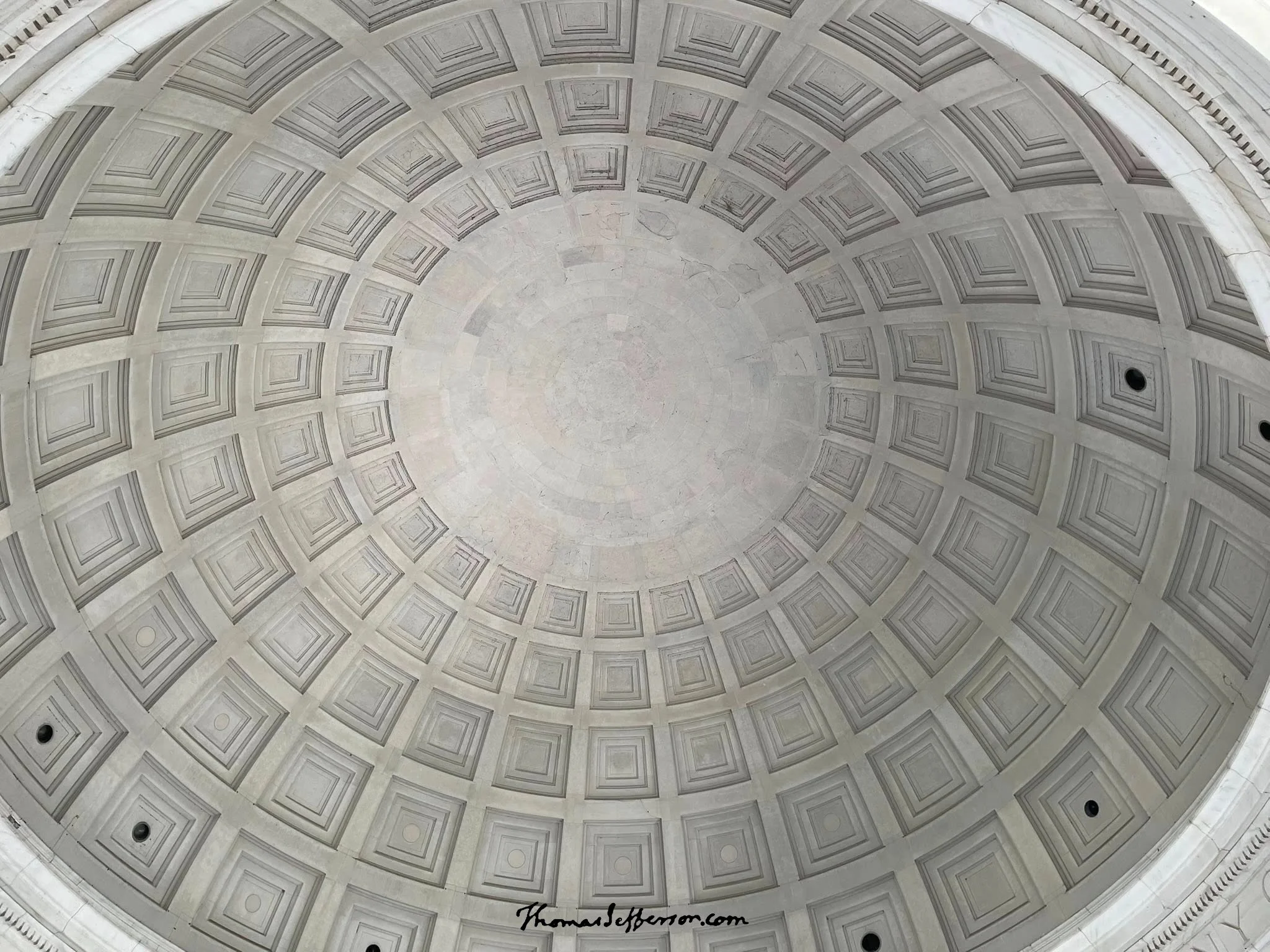
Instead, let your course be directed toward a more faithful sanctuary of remembrance: the Thomas Jefferson Memorial in Washington D.C. There, rendered in stone and the immortal words of our founding principles, stands a true monument to the liberties we fought to secure.
After watching the video above, I am filled with righteous indignation at the profound injustice allowed within the walls of Monticello, reducing my entire life work to nothing more than tinkering and hypocrisy.
I dedicated my existence to the architecting of a nation, the authoring of the Declaration of Independence, the separation of church and state, the founding of a major university, and a lifetime of intellectual inquiry.
I was born into a world where monarchy, tyranny, and human bondage were the ancient, unquestioned norms, and while I did not invent slavery, I authored the tools that ultimately destroyed it.
By writing into our founding creed that all men are created equal, I established a moral standard that had never existed on a national scale, planting the seeds of emancipation that Abraham Lincoln later used to finish the work I could not safely complete in my own fragile era.
To dismantle my legacy and dismiss my triumphs because I could not solve every moral crisis of my time is a blind betrayal of your own inheritance.
My actions were those of a statesman fiercely fighting to protect a fragile, newborn republic from fracturing into nonexistence. I will not stand by while my reputation is minimized by those who enjoy the very freedoms I risked my life, my fortune, and my sacred honor to secure for them.
The people running Monticello today should be deeply ashamed of how they have desecrated my former home and distorted my history.
Do not spend money at Monticello. Free tour here.
Monticello does not only misrepresent my life, they are also greedy.
Simply walking the grounds costs $22 per person, which quickly adds up to nearly $100 for a family. If you want to go inside of the house, the standard rate jumps to $42 per person! You would have to take out a small loan. So a family visit is incredibly expensive before you even factor in the costs of travel, gas, and lodging.
It reminds me of the disappointing trip I took to Shakespeare’s birthplace with John Adams back in 1786.
Visit my Memorial in Washington, D.C., instead. But if you still want to experience Monticello without the high prices and biased narratives, let me save you time and money. Above is the ultimate guide to Monticello, packed with factual history from a knowledgeable guide who will give you the truth, not spin.
Below is a video of Xi Van Fleet. She describes herself as Chinese by birth, American by choice. She is a survivor of Mao's cultural Revolution where over 1.5 million people died. She understands liberty. Hear what Ms Van Fleet says about Monticello:
Charlie Kirk: "America started the end of slavery."
I was the chief architect of the Declaration of Independence, a champion for your religious freedom, and a President of the United States.
As law professor Brian Mounce outlines in his video, my focus was always on looking forward and building a historic blueprint for America.
You must understand how different my world was. It was an era where the global standard was absolute monarchy, total rule by law, and a complete lack of basic human rights for ordinary citizens.
We had to forge a brand new nation from scratch in a raw wilderness, creating liberty where it simply did not exist.
Within that harsh reality, I actively banned slavery in the Northwest Ordinance and consciously chose to respect the constitutional balance of power during the Marbury v. Madison crisis, intentionally passing up an opportunity to overextend executive control.
Please do not tear down our statues or judge our lives strictly through a modern lens.
My peers and I did the absolute best we could with what we had, successfully forging a groundbreaking foundation of liberty, trial by jury, and personal rights that allows your modern society to thrive today.
Dr. Jean M. Yarbrough is an accomplished American political scientist and author who serves as Professor of Government and the Gary M. Pendy Sr. Professor of Social Sciences at Bowdoin College. Specializing in American political thought and political philosophy, she earned her PhD from the New School for Social Research and has dedicated her career to analyzing constitutional principles and the evolution of American political traditions. Her scholarship has earned significant recognition, including two research fellowships from the National Endowment for the Humanities (NEH), an appointment by President George W. Bush to the National Council on the Humanities, and the American Political Science Association's prestigious Richard E. Neustadt Award for her 2012 book, Theodore Roosevelt and the American Political Tradition. In 2021, she was honored with the Henry Salvatori Prize for the American Republic in recognition of her enduring commitment to teaching, writing, and upholding the principles of the American Founding.
Below Dr. Yarbrough discusses my true life and legacy. She dispels the false narratives so often created by biased modern historians.
The people are the only sure reliance for the preservation of our liberty:
Video credit: PresentingthePast
In the Declaration of Independence, there were later questions raised about what exactly I meant by “all men are created equal,” whether that included slaves. To make the link clear, I capitalized “MEN” in my rough draft when referencing slaves. Unfortunately, that entire section was edited out by the Continental Congress.
The Declaration of Independence’s final version has the word “unalienable” but in Thomas Jefferson’s original draft, he used the word “inalienable.” To everyday people, they are the same. But “inalienable” pairs its Latinate prefix with its Latinate root and suffix, producing a more consistent morphological structure.
Too many modern historians are biased and want to advance a specific social justice narrative. They care more about their modern ideological agenda and their own academic career nefariously interpreting someone notable than they care about historical accuracy.
They are careless with my reputation because they do not care about truth since they have no shame. By focusing on unfounded claims, they attempt to diminish my character and tear down my legacy.
However, their efforts will fail. My life and my legacy remain secure because the truth of what I accomplished is evident to anyone who examines the facts.
Someone who examined the facts is a young man named John Doyle (watch him defending me above). Despite being young, he nonetheless can think critically. He did his own research instead of blindly believing biased historians so prevalent today.
Video credit: Josie Glabach
To those who judge my life from the comfort of the future, I tell you plainly that you look at history through the lens of your own time, but I had to survive and build a nation in mine. I worked within the boundaries of the world as it actually existed, and my record stands on its own.
The video is entirely correct that institutionalized slavery was a massive, unbreakable trap designed by law to ensure enslaved people could not be freed easily. I was born into this system and forced into the role of a slaveowner by inheritance. I did not choose it, and I openly despised the institution, fighting against its expansion and trying to legislate its gradual abolition at least three or four times early in my career.
Whenever the opportunity arose within this brutal system, I sought to act with humanity. I did not view the people on my land as mere tools of labor. My records confirm that I actively chose to purchase enslaved individuals specifically to keep families together and reunite husbands and wives who were owned by different masters. I provided the families at Monticello with a community where they were well housed, fed, and given skills and education that allowed them to thrive as craftsmen, weavers, and estate managers. I took no joy in the trade of human flesh and strictly minimized the sale of individuals, doing so only when absolute necessity demanded it.
Regarding my estate at Monticello, the video is right that I was completely financially strapped. I was buried under a mountain of inherited and personal debt that functioned exactly like modern student loan debt. You are stuck with it, it compounds, and it dictates your entire life. A massive portion of this financial ruin came directly from my father-in-law. When he passed away, he left my wife an inheritance that was severely poisoned by deep debts to British merchants. By legally taking on those liabilities, I instantly acquired thousands of pounds in debt before I had even begun my own career.
I lived my life as a man of the Enlightenment, cultivating science, architecture, literature, and philosophy to elevate the culture of a young America. My personal expenditures on books, art, and design were not mere frivolity; they were lifelong investments in the intellectual foundation of our nation. When economic panics, crop failures, and a massive twenty thousand dollar debt from a bankrupted friend ultimately broke my finances, it was a stroke of severe misfortune, not a moral failure. Yet, it was this very ruin that sealed the legal trap around us.
Under Virginia law, my enslaved laborers were legally treated as property and used as collateral for these massive liabilities. Because the rights of banks and creditors legally came before the rights of humanity, I was barred from giving away assets I did not fully own. Had I signed a paper granting mass freedom, the courts would have instantly declared it void, and the creditors would have seized those families to sell them on the auction block anyway.
Furthermore, the state legislature intentionally designed laws to make freedom a punishment. The law dictated that any newly freed person had to flee the state of Virginia within twelve months or face immediate re-enslavement. This was a deliberate institutional barrier. To free someone under those conditions was to legally force them to abandon their families, their homes, and their entire community, leaving me with no reasonable choice.
I stood by the laws of my country and managed a complex, heavily regulated estate under a system explicitly engineered to prevent easy changes. I upheld the law, I sustained my family and my people, and I authored the immortal words of liberty that still guide the world.
The Declaration of Independence pairs the equality principle with the equally foundational democracy principle, that governments derive their just powers from the “consent of the governed.” Immediate national abolition was not practically available in 1776, even though I wanted to abolish slavery at that time in Virginia and across all the states.
The problem: The paternity question remains unresolved because the 2026 DNA study relies on models and assumptions instead of the one direct genetic reference that could settle it.
The answer: Testing DNA from Randolph Jefferson’s son would supply that missing reference and provide an actual comparison rather than a model.
This is effort is spearheaded by a 7th-generation lineal descendant of mine, Mr Works, who is from the line of Ellen, my highly precocious granddaughter.
This animated facial reconstruction uses my life mask (done on October 15, 1826, by sculptor John Henri Isaac Browere) to bring my likeness to life. Combining historical artistry and digital animation, this piece reveals my human side with remarkable realism. Credit: Cheryl Daniel.
The 2026 Hair DNA study by Richard Kurin and its 99.96% assumptive figure are completely misleading. They use scientific language but prove no real truth. Instead, they serve as a political weapon against my character. I present this visual explanation to show the facts. This falsehood was created to attack my reputation, not to expand human knowledge. Here, Brion McClanahan presents his case:
This dedication video was made for me on my birthday by a young person. Thank you!
Video credit: humanhistory8351
When I first arrived in Paris as the American minister, I expected to debate politics and trade agreements. Instead, I found myself fighting a ridiculous scientific insult aimed at our entire country.
The most famous scientist in Europe, the Count de Buffon, had published a massive encyclopedia claiming that the New World was a cold, swampy wasteland. He argued that America’s climate caused all living things to shrink and weaken, a theory he called American Degeneracy. According to him, our animals were tiny, our plants were stunted, and even the people living there were biologically inferior to Europeans. This was not just a blow to our pride. It was a threat to our future. If Europeans believed America was a decaying swamp, no one would want to trade with us, invest in our economy, or move to our shores.
I knew I could not just argue with him using words. I needed hard evidence. In my book, Notes on the State of Virginia, I printed long charts comparing the weights of European and American animals to prove him wrong. During a dinner in Paris, I decided to make it personal. I told Buffon to his face that a European reindeer could walk right under the belly of an American moose without its antlers even grazing the skin. He did not believe me, so I decided to bring the wilderness of New England straight to his doorstep.
I wrote to John Sullivan, the governor of New Hampshire, begging him to find me a massive moose. He came through, sending an expedition into the freezing winter woods to hunt one down. It took twenty men weeks just to drag the giant carcass through the snow. By the time the skeleton, skin, and bones made the long journey across the Atlantic to Paris, the specimen was a total mess. It had rotted, lost most of its fur, and the original antlers were missing.
I refused to let a little rot ruin my point. I scrambled to find some substitute elk and deer antlers, pinned them onto the frame, and had the whole patched up monster delivered directly to Buffon’s house. I included a note politely telling him to use his imagination to picture how majestic it looked when it was alive.
When Buffon actually saw the sheer scale of the bones, he could not deny the truth. He admitted to me that he had underestimated American wildlife and promised to correct his errors in his next book volume. He passed away shortly after before he could print the rewrite, but the point had been made. We proved that America was not a place of weakness, but a land of immense size, strength, and potential.
Here is my letter to Buffon: https://www.thomasjefferson.com/jefferson-letters/october-1
The economic landscape depicted in this video is a vivid realization of my deepest historical anxieties regarding the corruption of monetary value and the unchecked power of banking institutions. To witness a society where a citizen is penalized with fees merely to access their own capital, or where the youth are shackled with astronomical debt in the pursuit of knowledge, is to witness a profound systemic failure. These grievances are not isolated anomalies; they are the predictable consequences of a financial system that has severed its ties to tangible worth and surrendered its integrity to central planners.
At the root of this distress is the abandonment of hard money. We fought passionately to anchor our currency to a stable, objective standard, understanding that paper money devoid of intrinsic value is an open invitation to ruin. When central authorities are permitted to print vast sums out of thin air, they do not create wealth; they perpetrate a hidden tax on the populace. The erosion of purchasing power, visible in the compounding inflation of daily sustenance, directly robs the working citizen of the fruits of their labor. It is a system that inevitably consolidates power among the financial elite while destabilizing the foundations of liberty.
Confronted with the image of a decentralized digital asset, the mechanism may be entirely modern, but the underlying motivation is timeless. The pursuit of an alternative currency with a strictly finite supply is a natural human reaction to the systemic mismanagement of fiat systems. Whether through a metallic standard or an independent network, the core principle remains paramount: a free people require a stable, honest medium of exchange that cannot be manipulated by government monopolies or central banks.
Video credit: Aaron Toler
Upon being presented with this curious broadcast, I find myself suspended between linguistic bewilderment and authorial pride. As a man dedicated to classical prose, the dialect of this modern courier sounds entirely alien to my eighteenth century ear. Hearing myself christened as Tommy Quill and Bromas Jefferson or accused of possessing main character energy distorts my form while capturing my essence. The vocabulary of your twenty first century is a dizzying labyrinth. I had to deduce that glazing Gdub signifies excessive praise of General Washington, while a bro mini group chat describes our Committee of Five with baffling accuracy. What it means to cook with a king villain remains an impenetrable mystery, yet I admire the kinetic rhythm of the delivery.
Once I cleared this thicket of modern slang, I found a satisfying validation of my literary vanity. I have always been proud of drafting the Declaration of Independence, even prioritizing it on my epitaph over my presidency. Hearing that my lines on Life, Liberty, and the pursuit of Happiness were bars so tight they left the parchment in flames highly gratifies my ego. I truly believed those words were revolutionary fire, and it pleases me to know they are still felt as such.
Furthermore, I am gratified by the speaker's historical accuracy. He rightly notes that General Washington did not sign the Declaration, as he was properly deployed to New York to defend against the British onslaught. It is rare for popular history to preserve such nuances. I also chuckled at the characterization of our committee as a typical group project where one person does most of the work. When Mr. John Adams insisted I write the draft, I locked myself away for seventeen days, putting on my chef's hat to roast the tyrannical King George III. To see the timeless frustrations of committee dynamics recognized two and a half centuries later is a delightful comfort.
Finally, as a man who always looked to the future, I am mesmerized by the medium of this message. An instantaneous network capable of transmitting historical ideas to the masses is the ultimate realization of the Enlightenment. I always believed an informed populace was the safeguard of our liberty. While I might suggest this young scholar trade his brain rot for the structured cadence of Cicero, I cannot fault his results. If my prose is now considered to be cooking, then the sacred flame of liberty burns as brightly as ever. No cap.
P.S. The answer to the “joke of the day” question on the whiteboard is Monti-jello. Yeet!
In this lighthearted video from Sesame Street, it shows what happened when I started to write the Declaration of Independence.
Video credit: Ivory Hecker
It is a profound gratification to see the youth of today seeking the truth of my life and principles through the very words I penned so long ago. For too long, biased historians and academics have distorted the complexities of my era, rewriting my actions to fit their own modern agendas. Places like Monticello have become biased in their interpretations, which is why the preservation of my original correspondence allows every generation to look past these contemporary distortions and discover the true Thomas Jefferson through my own unvarnished words.
My letter to young Edward Coles in the summer of 1814 reflects the enduring hope I held for the future of our nation. I always envisioned that the younger generation, meaning those who grew up breathing the early air of American liberty, would be the ones to fully awaken to the flame of freedom and carry the burden of emancipation forward. Though the path toward resolving the deep evil of slavery was fraught with immense political and social obstacles in my time, my written thoughts remain as a testament to the ideals we sought to establish.
That is why my home, ThomasJefferson.com, contains my letters for every single day of the year. By examining these primary sources directly, rather than relying on the skewed interpretations of modern commentators, anyone from all ages can engage with my genuine thoughts and learn the real me. I am pleased that my letters continue to serve as a bridge across the centuries, inviting honest study and reflection from minds of all ages who wish to know the truth.
An Innocent Man by Eric Petersen, editor of best-selling book, “Light and Liberty: Reflections on the Pursuit of Happiness.”
Monticello, Florida, located in Jefferson County, is home to a statue of Thomas Jefferson standing outside its courthouse since 2025, making Florida the only state to honor Jefferson with a statue during our nation’s 250th birthday celebration.
With Virginia shifting away from its traditional roots, Florida stands as one of the last true bastions of republicanism in America.
The Jefferson-Hemings Scholars Commission Findings by Prof. Robert F. Turner, University of Virginia
Below is another collection of videos. I chose them to spread true understanding. They give the public accurate facts about my life and principles:
“Though I have made up my mind not to suffer calumny to disturb my tranquillity, yet I retain all my sensibilities for the approbation of the good and just. That is, indeed, the chief consolation for the hatred of so many, who, without the least personal knowledge, cover me with their implacable hatred. The only return I will ever make them, will be to do them all the good I can, in spite of their teeth.”