
Regarding the Jewish people
To look upon the accusations leveled against my memory in your modern era is to witness a profound misunderstanding of the Enlightenment mind. When contemporary critics read my private papers and accuse me of harboring a hatred toward the Jewish people, they are fundamentally confusing a harsh philosophical critique of an ancient theology with malice toward a human population.
As a student of nature and a disciple of reason, I subjected all ancient religions based on divine revelation to rigorous, unsparing scrutiny. I wrote scathingly about the dogmas of priests, the supernatural claims of scripture, and what I perceived to be the severe nature of the ancient Hebrew deity. Yet, I leveled this same critical lens at the corruptions of Christianity, the dogmas of the Catholic Church, and the sour tenets of the Calvinists. My philosophical disagreements with ancient Jewish theology never diminished my fierce, lifelong defense of Jewish individuals as equal citizens who deserved full integration into the American republic.
My private skepticism toward historical creeds is often highlighted by critics who extract specific lines from my confidential philosophical musings, such as my 1803 memorandum written to Benjamin Rush, where I stated regarding the Jews:
"Jews. Their idea of God and his attributes are degrading and injurious. Their ethics are not only imperfect, but often irreconcilable with the sound dictates of reason and morality; repulsive and anti-social, as respecting other nations."
To the modern ear, these words sound shockingly harsh, but to understand them truly, one must realize that I was critiquing an ancient system of tribal theology, not attacking a living population of people. My lifelong approach to religious texts was that of a scientist and a historian, not a theologian. I viewed the early Hebrew conception of the deity as an entity of terrors, a being whose depicted actions often violated the universal laws of natural justice and benevolence that reason reveals to us.
Yet, the vital distinction that the modern reader must make is the absolute line I drew between theological criticism and civil right. My active support for the Jewish people is woven directly into my legislative career and private correspondence, serving as a primary test case for my dedication to absolute religious freedom. When I looked upon the laws inherited from British colonial rule in Virginia, I found them entirely incompatible with liberty. Under the old system, Jews and other religious dissenters faced massive legal disabilities, including restrictions on property ownership and a total ban from holding public office. I explicitly authored the Virginia Statute for Religious Freedom to destroy these barriers. When it passed, I proudly noted that its protection was not merely designed for various sects of Christians, but was intentionally broad enough to encompass the Jew, the Mahometan, and the Hindoo alike, shielding all from the tyranny of a state church.
I was under no illusion that passing a law would instantly cure centuries of hatred, and I frequently used my pen to defend the Jewish population against lingering social prejudices. In my May 28, 1818 letter to Mordecai Manuel Noah, a prominent Jewish diplomat and journalist, I confronted the reality of American bigotry head on. I wrote directly to Noah that while our laws had successfully applied the only true antidote to intolerance by putting all faiths on an equal footing, a stubborn social prejudice still scowled upon his section of religion. I openly lamented that the Jewish people had been singled out by Christendom for centuries of cruel persecution and oppression. I stated that public opinion in America desperately needed a moral reformation so that individual citizens would finally align their private dispositions with the egalitarian model of our laws.
To fully integrate Jewish citizens into the leadership of the nation, I believed they must also have unhindered access to secular knowledge. I corresponded with Isaac Harby, a Jewish educator and advocate, to condemn the historical practice of forcing Jewish youth to study Christian theology in public schools. I called such requirements a cruel addition to the wrongs which that injured sect have suffered that their youths should be excluded from the instructions in science afforded to all others in our public seminaries by imposing on them a course of theological reading which their consciences do not permit them to pursue. To remedy this, I proudly designed the University of Virginia as the first major American institution completely free from religious doctrines or theological tests, ensuring a secular curriculum so that Jewish students could study science without compromising their faith or being subjected to Christian theological indoctrination.
Perhaps the most poignant vindication of my true principles came not during my life, but long after I had departed it, through the profound stewardship of my beloved former home, Monticello. (My home now is ThomasJefferson[dot]com.) Following my death, my family was forced to sell the estate to settle my catastrophic debts, leaving the house to fall into a state of severe neglect and decay. It was a Jewish man, Commodore Uriah Phillips Levy, an officer in the United States Navy who deeply revered my memory, who purchased the property. Driven entirely by his love for me and his devotion to my principles of religious liberty, Levy purchased Monticello to preserve it as a monument to the architect of American freedom. He and his family dedicated their lives, their fortunes, and nearly a century of meticulous care to rescuing the estate from ruin. That a Jewish family became the self appointed guardians of my earthly legacy stands as an enduring historical testament to the bond of mutual respect that united us.
To look back at my legacy is to see a sharp division between my private, intellectual doubts regarding ancient scripture and my public, unyielding protection of human beings. I did not require an individual to share my theological views in order to merit my respect and protection. To my mind, the true success of the American experiment would always be measured by how safely and equally a Jewish citizen could live, learn, and govern alongside his fellow countrymen, free from the heavy hand of both the magistrate and the mob.
(Pictured are members of the Levy family who owned Monticello for 89 years. They revered my memory, unlike the current management.)
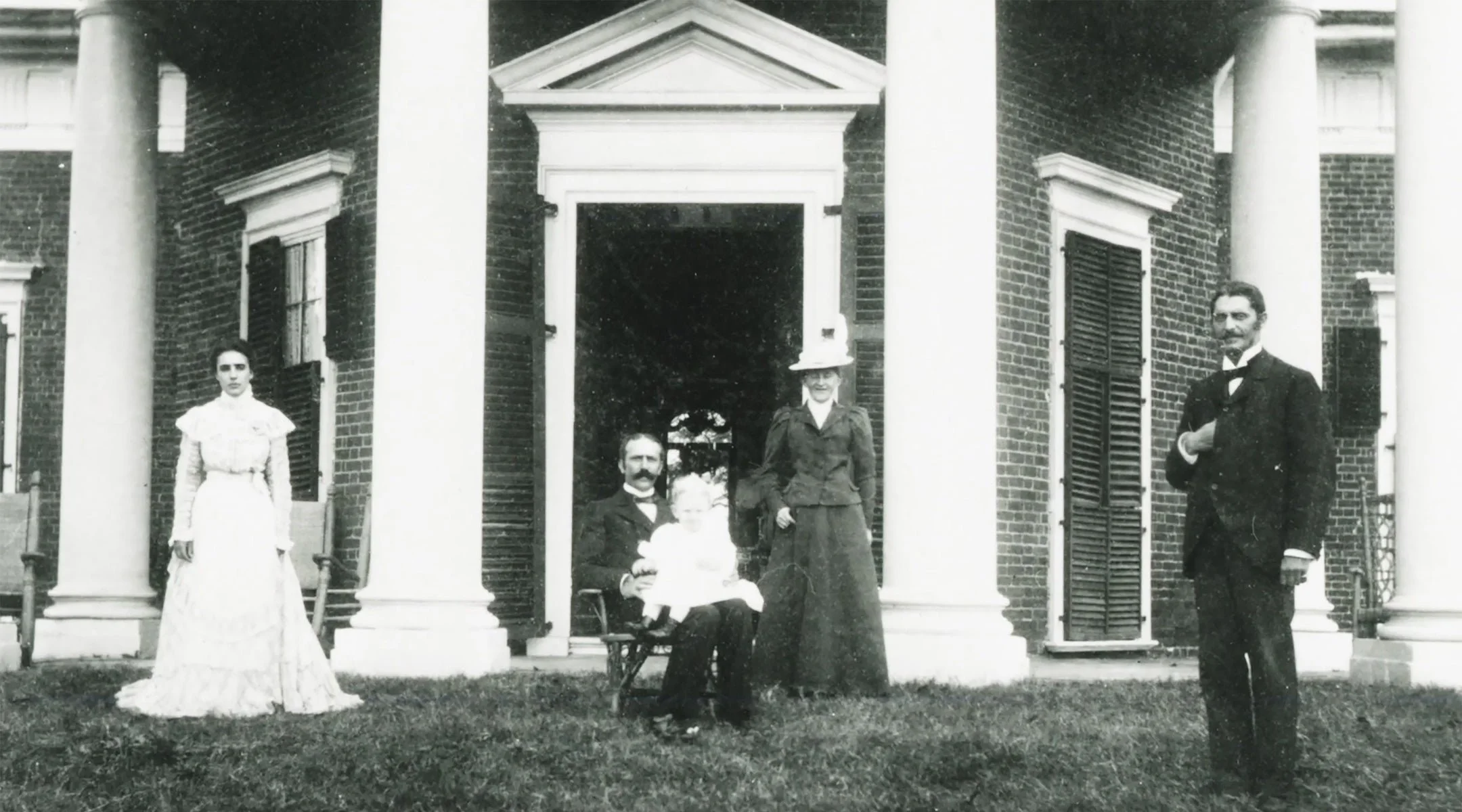
Pictured are members of the Levy family who owned Monticello for 89 years. They revered my memory, unlike the current management.