The Pursuit of a Happy, Healthy Life
Thomas Jefferson lived to the remarkable age of 83, dying on July 4, 1826, the 50th anniversary of the Declaration of Independence. To understand how unusual his longevity was, one has to look at the life expectancy of his era. In the late 1700s and early 1800s, the average life expectancy at birth in America was only about 35 to 40 years, meaning Jefferson lived more than double that average, or well over 100 percent longer than expected from birth. Even when accounting for high infant and childhood mortality rates, an adult man who survived his early years could usually only expect to reach his early sixties, putting Jefferson over 30 percent ahead of his adult peers.
Out of the 56 men who signed the Declaration of Independence, Jefferson outlived 53 of them. He stood as one of the last three surviving signers alongside John Adams, who died just hours after him that very same day, and Charles Carroll of Carrollton, who lived until 1832. Jefferson stayed trim, active, and mostly healthy well into his eighties, relying on extraordinary personal discipline and practicing habits that modern science would not fully prove for another two centuries.
That unwavering discipline started at the dinner table long before nutritionists promoted plant-based diets. Jefferson practiced strict moderation with every meal, treating meat not as the main dish, but as a side condiment used simply to flavor his food. Instead, he filled his plate with fresh vegetables and fruits grown in his own gardens. Modern nutrition science now confirms that plant-rich diets lower inflammation, protect blood vessels, and sharply reduce the risk of chronic disease.
When it came to drinking, Jefferson avoided hard spirits altogether, preferring fine wines that he often watered down. He drank wine regularly with meals, never to the point of drunkenness, a pattern that modern cardiovascular studies have linked to heart health and longevity.
Remarkably, despite growing up on a Virginia plantation where tobacco was everywhere, his self-control kept him from ever smoking, chewing, or using snuff. Medical research has long since proven that avoiding tobacco is one of the single biggest factors in preventing heart disease and cancer. Combined with his clean diet, this lifelong discipline helped him keep all of his natural teeth, and at age 76 he proudly noted that he had never lost a single tooth to old age.
Jefferson brought that same steady discipline to his daily sleep schedule, mastering healthy body rhythms long before anyone had a smartwatch or fitness tracker to monitor their rest. He famously shared that for 50 straight years, the sun had never caught him in bed, waking up the moment there was enough morning light to read the clock across his room. Modern sleep researchers know that waking up consistently with natural morning light anchors the body's internal clock, balancing hormones and boosting daytime energy. At night, he protected his rest by refusing to let political stress follow him to bed, keeping a strict rule to spend 30 to 60 minutes reading calming moral philosophy before turning in, a wind-down routine that sleep doctors still recommend today to quiet the nervous system.
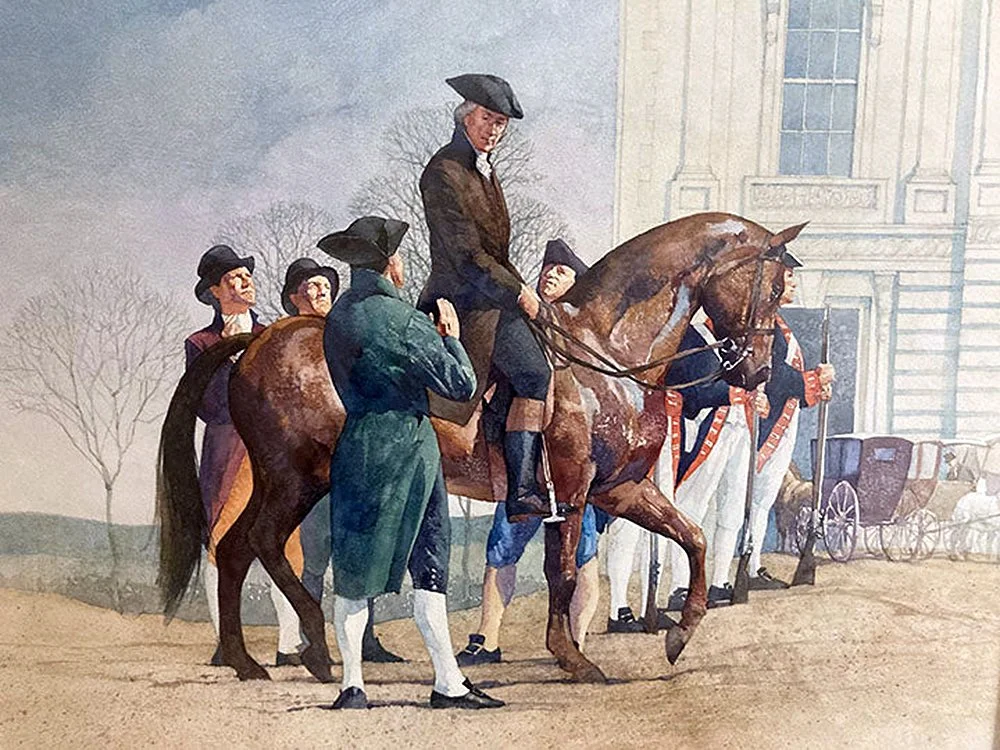
Physical movement was the cornerstone of Jefferson's waking routine, and he never let a busy schedule break his habit. He famously wrote that of all exercises, walking is the best, and he made sure to spend at least two hours outside every single day. Whether he was walking his Virginia estate while humming his favorite tunes, riding his beloved horses Caractacus and Eagle, or going shooting in the woods, he prioritized breathing fresh country air over the crowded, smoky air of cities. Modern public health studies show that regular daily walking strengthens the heart, regulates blood sugar, and adds years to human life, while avoiding polluted urban air protects the lungs and brain.
Modern cognitive science also confirms that Jefferson's daily habit of walking in the woods was one of the smartest things he could do for his mind. Researchers studying attention restoration have found that walking in natural, wooded spaces rests the part of the brain responsible for heavy focus and decision-making. Brain scans and memory tests show that spending even 40 to 50 minutes walking among trees lowers stress hormones, quiets anxious thoughts, and sharpens working memory and problem-solving far better than walking on a busy city street.
Jefferson understood this connection intuitively long before brain scans existed. In a 1785 letter to his nephew Peter Carr, he advised taking a two-hour walk every day without bringing a book, telling him not even to force himself to think, but simply to let the surrounding woods and nature refresh his mind.
To keep his body just as resilient as his mind, Jefferson also maintained the daily discipline of bathing his feet in cold water every morning for 60 years. He credited this habit partly for catching a bad cold only once every eight or ten years and having a lasting fever only two or three times in his life. Modern cold-water therapy research echoes his experience, showing that brief cold exposure stimulates circulation, strengthens the nervous system, and supports immune response. Even during the coldest winter months, Jefferson refused to stay cooped up inside, wrapping himself in his favorite wolfskin pelisse so he could keep enjoying the fresh outdoor air.
Later leaders recognized how vital this physical discipline was to Jefferson's brilliance. On December 5, 1961, President John F. Kennedy spoke about the ancient Greeks and their belief that the mind and body must develop together in harmony. Kennedy pointed directly to Jefferson, noting that a man who wrote the Declaration of Independence, served as Secretary of State, and was twice President still had the discipline to give two hours to daily exercise. Kennedy used Jefferson's example to argue that modern children could certainly spare ten or 15 minutes a day for physical fitness.
When it came to medical care, Jefferson stayed disciplined against the popular trends of his day. 18th-century doctors routinely used harsh treatments like bloodletting and toxic mercury pills, which Jefferson deeply distrusted. Modern medical history confirms his instincts were right, as those aggressive treatments often weakened patients more than the illnesses themselves. Instead, he believed in letting nature, rest, fresh air, and gentle nursing heal the body whenever possible.
At the same time, he was a fearless champion of preventive science. In 1766, at just 23 years old, he traveled all the way to Philadelphia to undergo the early smallpox inoculation himself, even when it was frowned upon back home in Virginia. Decades later, in the summer of 1801, he enthusiastically embraced the safer new cowpox vaccine, arranging for around 200 people, including his own family, slaves, and neighbors, to be vaccinated to prevent deadly outbreaks. Modern immunology stands on the exact principle he championed, proving that community-wide vaccination stops infectious diseases before they can spread.
Modern science also confirms that strong social ties and an active mind are essential for a long life, and Jefferson excelled at both. Landmark longevity studies show that close relationships protect against cognitive decline and early mortality just as powerfully as diet and exercise. Jefferson surrounded himself with a tight circle of family and friends, deeply cherishing his wife Martha, his children and grandchildren like Patsy, Jeff, Ellen, Cornelia, and Francis, and loving to buy toys and gifts for them.
He also treasured deep, enduring friendships with his youth best friend Dabney Carr, Maria Cosway, the Marquis de Lafayette, and fellow thinkers and statesmen like Benjamin Franklin, James Madison, James Monroe, Meriwether Lewis, and John and Abigail Adams. He learned from and corresponded with mentors and peers such as George Wythe, William Small, Peyton Randolph, Francis Fauquier, Dr. Benjamin Rush, Spencer Roane, Joseph Cabell, and Wilson Cary Nicholas.
To nurture these friendships and share ideas across the world, Jefferson dedicated hours every single morning from dawn until midday to writing letters, producing more than 19,000 over his lifetime. Modern psychology and brain research show that regular expressive writing organizes complex thoughts, lowers emotional stress, and strengthens memory and verbal sharpness well into old age. Even when arthritis in his right wrist made writing painful later in life, Jefferson used a polygraph copying machine and eventually trained himself to write with his left hand rather than give up his daily habit. Neuroscientists today note that using the non-dominant hand forces the brain out of autopilot, activating new neural connections across both hemispheres and boosting brain plasticity well into old age.
When Jefferson was not writing at his desk, outdoors, or with loved ones, he kept his mind constantly engaged at home, often wearing comfortable clothes and slippers. Neuroscientists today call this building cognitive reserve, noting that lifelong reading, learning new languages, and solving complex problems keep brain pathways strong into old age. Jefferson's curiosity knew almost no bounds. He read ancient classics in Greek and Latin, studying thinkers like Tacitus, Epicurus, and Epictetus alongside Enlightenment minds like John Locke, Francis Bacon, Isaac Newton, and William Shakespeare. After losing his early book collection in a 1770 fire, he built a massive library of 6,487 volumes that he sold to establish the Library of Congress, and then immediately began collecting a brand-new library for himself.
His daily hobbies also aligned with what modern psychology links to emotional well-being and healthy aging. Through his work with the American Philosophical Society, he studied natural science, botany, horticulture, architecture, and even prehistoric fossils like the Megalonyx. He loved playing chess, practicing the violin, cooking, inventing practical household gadgets, keeping pet mockingbirds, and studying Native American languages. He also held a deep affection for Paris and French culture from his time serving abroad. Today, researchers recognize that playing musical instruments, gardening, and hands-on creative problem-solving reduce stress, improve coordination, and keep the aging brain sharp.
All of these personal habits and his lifelong self-discipline fed directly into his devotion to public service and advancing American interests. Modern behavioral science has found that having a strong sense of purpose in life is one of the strongest predictors of healthy aging and longevity. Even after retiring from the presidency, Jefferson poured his energy into founding the University of Virginia and remaining an active thinker until the very end. Through steady discipline in his body, his mind, and his purposeful service to others, Thomas Jefferson showed that the daily pursuit of mental and physical exercise is the true secret to a long, happy, and healthy life.