Thomas Jefferson's best friend
Almost everyone grows up with that one special friend, a best buddy who knows all your secrets and shares your biggest dreams. For Thomas Jefferson, that person was Dabney Carr. Born in October 1743, just six months after Jefferson, Dabney grew up right alongside him in Virginia.
Their bond started in the late 1750s at Reverend James Maury's log cabin boarding school. Both boys loved books, history, and big ideas, and they later went off to the College of William and Mary together. On summer breaks, they loved riding their horses up a steep wooded mountain near Jefferson's childhood home. They would stretch out under a huge oak tree, read all day, and talk about the future.
One afternoon, they made a serious promise that whoever died first would be buried under that exact oak tree, and the other would eventually be buried beside him. Remember this, because I will come around to it again.
As young men, their lives locked together even tighter. Both became Virginia lawyers, and in July 1765, Dabney married Jefferson's younger sister, Martha.
Now officially brothers, they jumped into politics side by side. When Dabney joined the Virginia legislature in 1771, he was still in his 20s and barely known outside his county. Yet on March 12, 1773, he stood up and gave a speech so powerful that even Patrick Henry's supporters were amazed.
Dabney suggested creating committees to connect the colonies, a network that helped the American colonies talk and work together during the Revolution. Before Dabney's speech, the 13 colonies mostly faced British crackdowns alone. His plan linked them together to share news and directly led to the First Continental Congress. Had Dabney lived longer, he almost certainly would have signed the Declaration of Independence right next to Jefferson.
Then tragedy hit out of nowhere. In May 1773, while Jefferson was away on legal work, Dabney caught a terrible fever at Shadwell, Jefferson's childhood home. He died on May 16, 1773, at just 29, leaving behind a heartbroken wife and six young kids, including a baby boy born 19 days earlier.
Because Jefferson was out of town and May heat sets in fast, the family went ahead and buried Dabney down in the valley at Shadwell.
When Jefferson rode back and found his best friend buried somewhere else, he refused to leave it that way. Determined to keep their teenage promise, he right away told workers to dig up Dabney's coffin, carry it up the steep mountain to Monticello, and bury him again right under their favorite oak tree.
Even through deep sadness, Jefferson could not turn off his number-loving brain. While enslaved workers dug the new grave, Jefferson sat nearby with a watch and notebook, timing how long it took two men to dig through Virginia clay. He wrote down that it took three and a half hours and jotted down a math problem showing that one man could dig up an acre of dirt in four days. Measuring things around him was how Jefferson kept himself from falling apart.
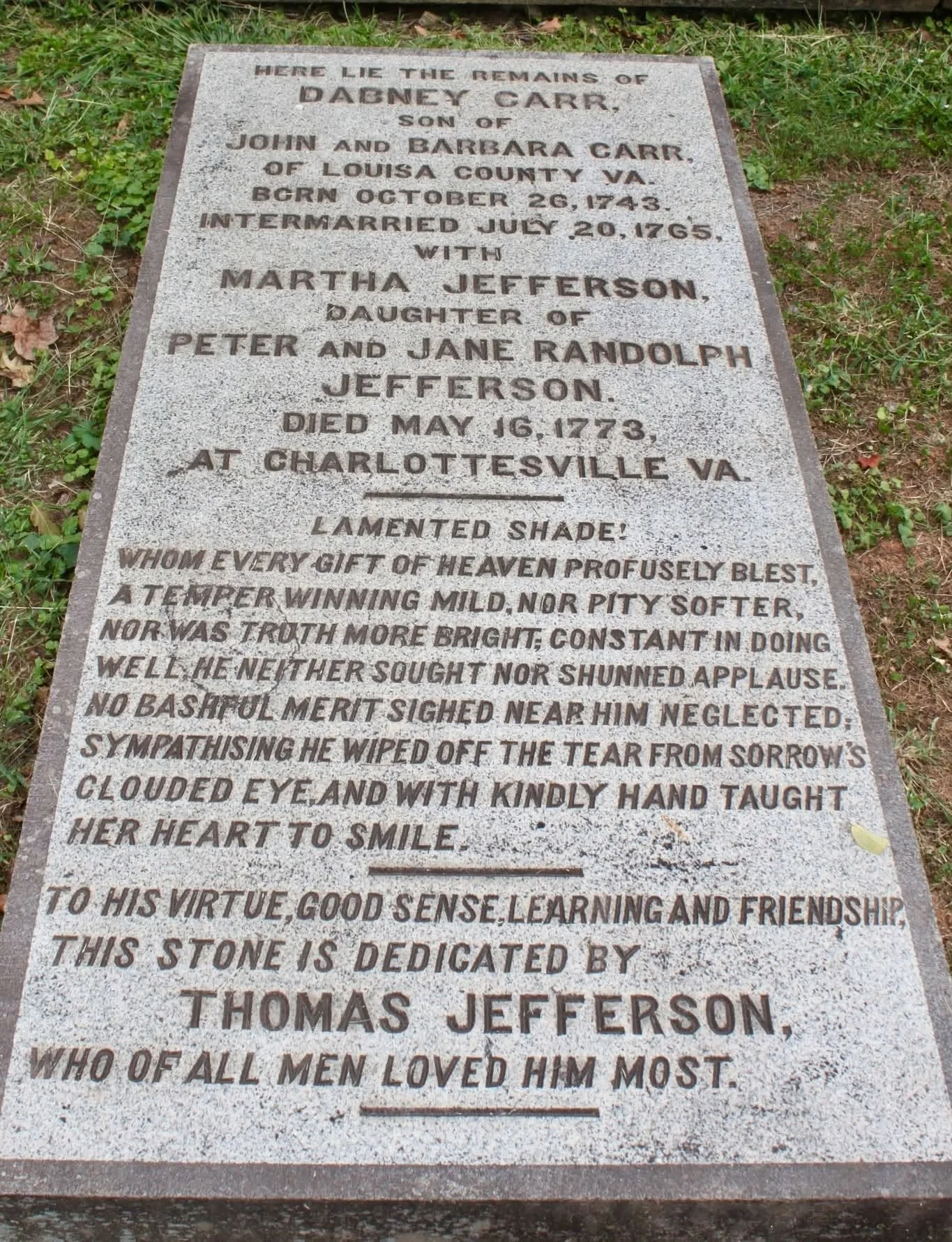
Jefferson also wrote the words on Dabney's gravestone himself, calling him a friend who "of all men, loved him most." (See photo.) By burying Dabney under that oak, Jefferson officially started the Monticello graveyard, making his best friend the first person buried on the mountain.
Jefferson kept his promise to Dabney's family too. He stepped in to raise all six children, eventually moving his sister Martha and the kids right into Monticello. He picked out their books, paid for their schooling, and treated them as his own. His oldest nephew, Peter Carr, became like an adopted son, while the newborn baby grew up to sit on Virginia's highest court as Judge Dabney Carr.
53 years later, on July 4, 1826, Thomas Jefferson died at 83. True to the promise two teenagers made in the Virginia woods, he was buried at Monticello right beside Dabney Carr. Today, Dabney's grave still sits next to Jefferson's stone monument, showing that behind one of America's greatest Founding Fathers stood a young best friend he never stopped missing.