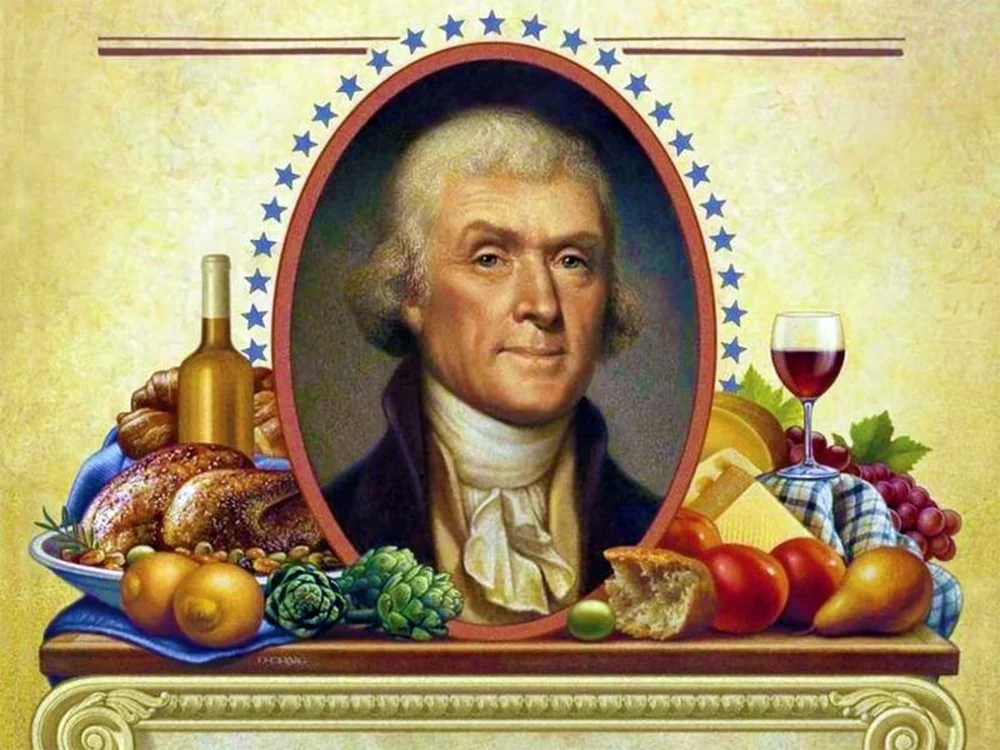
Thomas's Thanksgiving
Most Americans today picture Thanksgiving as a cozy day of turkey, football, and family time. Yet in the early days of the United States, the holiday sparked a bitter political fight. When Thomas Jefferson became the third president in 1801, he broke a tradition started by George Washington and continued by John Adams. Both of those earlier presidents issued official notices asking Americans to set aside a day for prayer, fasting, and thanking God. Jefferson refused to do the same, and that choice turned him into a villain in the eyes of his political rivals.
To see why Jefferson acted this way, it helps to look at how divided American politics were back then. Jefferson led the republicans (written with a lowercase r, as that is what he and his coalition called themselves, and it has nothing to do with today's political party), who wanted to keep the central government small and out of people's daily lives. His rivals were the federalists, who wanted a stronger national government. Many federalists lived in New England, where autumn Thanksgiving days were already a beloved local tradition.
Because Jefferson refused to declare a national day of thanks, federalist newspapers and preachers attacked him nonstop. They claimed he was an atheist who wanted to wipe out religion in America. The funny thing is that Jefferson had actually declared a Thanksgiving day himself earlier in his career.
Back in 1779, during the American Revolution, he was serving as the governor of Virginia. Following a recommendation from the Continental Congress and a related bill drafted by Virginia's legal revisors, Governor Jefferson acted under state authority to sign a proclamation naming December 9 as a day of public Thanksgiving and prayer. So why was it okay for him to do it in Virginia, yet completely out of the question when he became president 22 years later?
The answer came down to how Jefferson read the Constitution, especially the First Amendment and the Tenth Amendment. Together, these rules set up federalism, which splits power between the national government and the state governments. Jefferson believed that what worked for Virginia was not automatically right for every other state, since each state had its own customs, laws, and religious habits.
In his mind, the First Amendment stopped the central government from meddling in religion, while the Tenth Amendment left any extra powers to the states and the people. Under state laws, a governor had the constitutional right to suggest a day of prayer for their own state. On the other hand, Jefferson believed the president represented all states under a strictly limited central government and had no authority over religion.
Jefferson almost shared this whole argument with the public in early 1802. He got a friendly letter from a group of Baptists in Danbury, Connecticut, who were being treated unfairly over their religion in their home state. Jefferson saw his reply as the ideal moment to explain why he refused to issue Thanksgiving notices. In his rough draft, he spelled out his thinking, calling national religious notices a bad mix of church and state.
Before sending the letter, though, he showed the draft to his attorney general, Levi Lincoln, who was from Massachusetts. Lincoln warned him that criticizing Thanksgiving days would upset voters in New England, even the ones who liked the republicans. Taking his friend's advice, Jefferson heavily crossed out that part of the letter. He left in his famous line about a wall of separation between church and state, while keeping his thoughts on Thanksgiving to himself.
Years later, in the 1990s, historians teamed up with the FBI to use special scanners to read the words Jefferson had scribbled out on that 1802 draft. Those hidden lines proved that his silence was a smart political move, not a hatred of giving thanks. Jefferson finally put his full thoughts on paper in an 1808 letter to a Presbyterian minister named Samuel Miller. In it, he explained that even a polite suggestion from the president carried the heavy weight of the central government behind it, crossing the line into state and personal matters.
Even though Jefferson never gave in on the holiday during his eight years in the White House, he still left a fun mark on the modern Thanksgiving dinner table. While living in France in the 1780s, Jefferson grew fond of pasta dishes and brought pasta-making equipment back to Virginia. His French-trained chef, James Hemings, whom Jefferson freed in 1796 before Hemings passed away in 1801, played a central role in introducing French-style macaroni dishes at Monticello and beyond. Jefferson later served baked macaroni and cheese at White House dinners, helping make the dish popular across America.
Today, Thanksgiving is a permanent national holiday thanks to Abraham Lincoln, who made it official in 1863, and millions of people still enjoy that famous side dish every November. Yet Jefferson's refusal to declare the holiday carries an even bigger lesson for us today. Nowadays, many people do not realize how often the central government overreaches beyond what it should. Whenever leaders ignore the strict limits set by the Constitution, their actions and laws become unconstitutional. That is why reading and understanding the Constitution is so important, and why the concept of federalism mattered so much to Jefferson, and should matter just as much to you today.