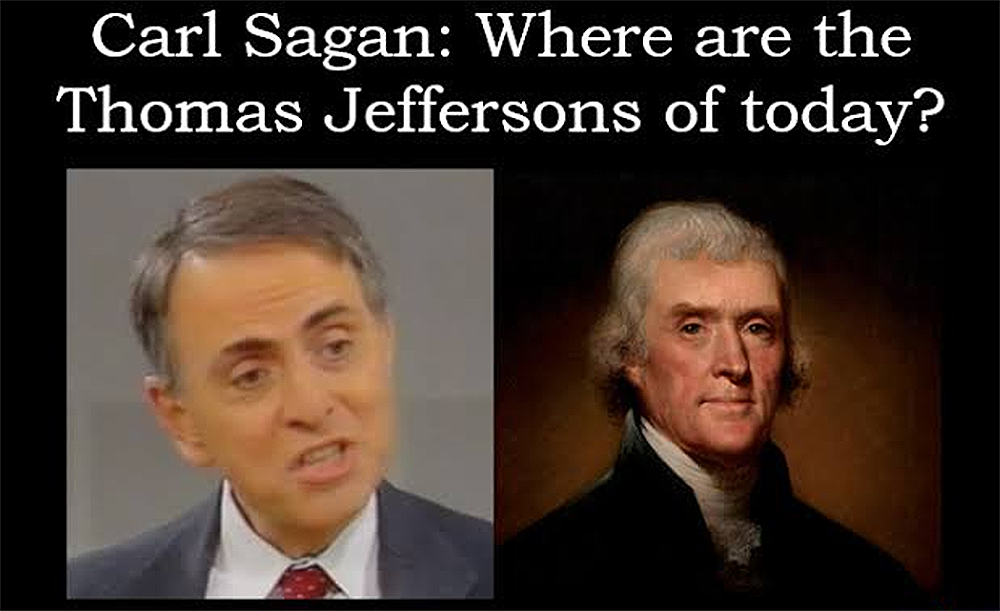
Where are the Thomas Jeffersons of Today?
In 1995, the famous astronomer Carl Sagan published a book called The Demon-Haunted World: Science as a Candle in the Dark. Near the end of the book, in a final chapter focused on how scientific thinking protects free societies, Sagan looks back at the founding of the United States. He points out that when the nation began, there were only about 2.5 million citizens, yet that small population produced at least ten leaders of extraordinary intellect and character, including Thomas Jefferson, Benjamin Franklin, George Washington, John Adams, and James Madison. Sagan notes that with a population roughly 100 times larger in his own day, basic math suggests there ought to be 1,000 people of Thomas Jefferson's caliber walking around America, leading him to ask where they all are.
To understand why Sagan asks this question, it helps to look at the broader message of his book. Throughout The Demon-Haunted World, Sagan warns that a modern society cannot survive if its citizens abandon critical thinking, science, and open debate. When he looks at the American founders, he sees leaders who were deeply educated in history and the European Enlightenment. They understood human flaws and greed, so they designed the Constitution and the Bill of Rights not to dictate every rule, but to set limits on government power. Sagan views the American system of government as a self-correcting machine, much like the scientific method itself, where bad ideas can be tested, challenged, and replaced without bloodshed.
Sagan's deep admiration for Thomas Jefferson goes far beyond a passing mention in a single chapter. Jefferson was Sagan's childhood hero, and Sagan spoke about him often in books, television interviews, and public speeches. In fact, on July 4, 1992, Sagan gave a speech at Monticello, Jefferson's home in Virginia, where he explained why Jefferson meant so much to him. Sagan praised Jefferson as the person most responsible for spreading the radical idea that ordinary people, rather than kings, priests, or dictators, should rule themselves.
Another major reason Sagan was such a big fan of Jefferson was their shared love of science. Sagan frequently pointed out that Jefferson considered himself a scientist at heart and would have preferred to spend his life studying nature, farming, and inventing rather than serving in politics. Even while serving as president, Jefferson kept up with scientific discoveries, collected fossils, and encouraged exploration. Sagan believed that Jefferson's political work in helping build a free nation made it possible for future generations of Americans, including Sagan himself, to pursue science openly without fear of punishment from the state.
Ultimately, Sagan admired Jefferson because both men believed that science and democracy rely on the exact same habits of mind. Neither science nor a free republic works well when people blindly obey authority. Both require citizens to ask hard questions, demand evidence, and stay skeptical of anyone claiming to hold absolute truth. Sagan often repeated Jefferson's warning that a self-governing nation cannot remain both ignorant and free.
Today, the answer to Sagan's question about why we no longer see people like Thomas Jefferson or Carl Sagan, himself a great admirer of Thomas Jefferson, lies heavily in the state of our modern cultural and academic institutions. Instead of encouraging the fearless, evidence-based inquiry that both men championed, institutions like Monticello and biased modern historians have promoted falsehoods that stain Jefferson's reputation. Many scholars readily accept these narratives in the name of progressive social justice movements, driven by fear that resisting the prevailing orthodoxy would put their careers and reputations in jeopardy within an out-of-touch academic world.
Because of this climate of conformity, almost no one in academia has the backbone to push back publicly, even if they harbor doubts in private. When institutions built to preserve history instead tear down the very figures who made our freedoms possible, they discourage the exact kind of independent, principled thinking that produces great leaders and scientists. Considering everything Thomas Jefferson sacrificed to secure the liberties and benefits Americans enjoy every single day, the modern critics and cowards who attack his legacy without courage or honesty are not fit to buckle his shoes.
The most tragic result of this smear campaign is what it has done to the next generation. Unlike young Carl Sagan, who looked up to Jefferson as a role model for curiosity, freedom, and intellect, no young child wants to be Thomas Jefferson anymore, and that is outrageously wrong. When children are taught to view their nation's greatest thinkers with suspicion and shame rather than pride and inspiration, we cut them off from the very ideals that built a free society. By trading honest debate and genuine admiration for ideological conformity, society has destroyed the environment that once inspired young minds to grow into the next Sagan or Jefferson.