Why Thomas Jefferson Belongs to Every American
When people talk about American politics today, it is easy to think that leaders from different political parties have nothing in common and are constantly fighting. Yet if you look closely at our history, there is one founder whose ideas rise above every party label and every era. That man is Thomas Jefferson.
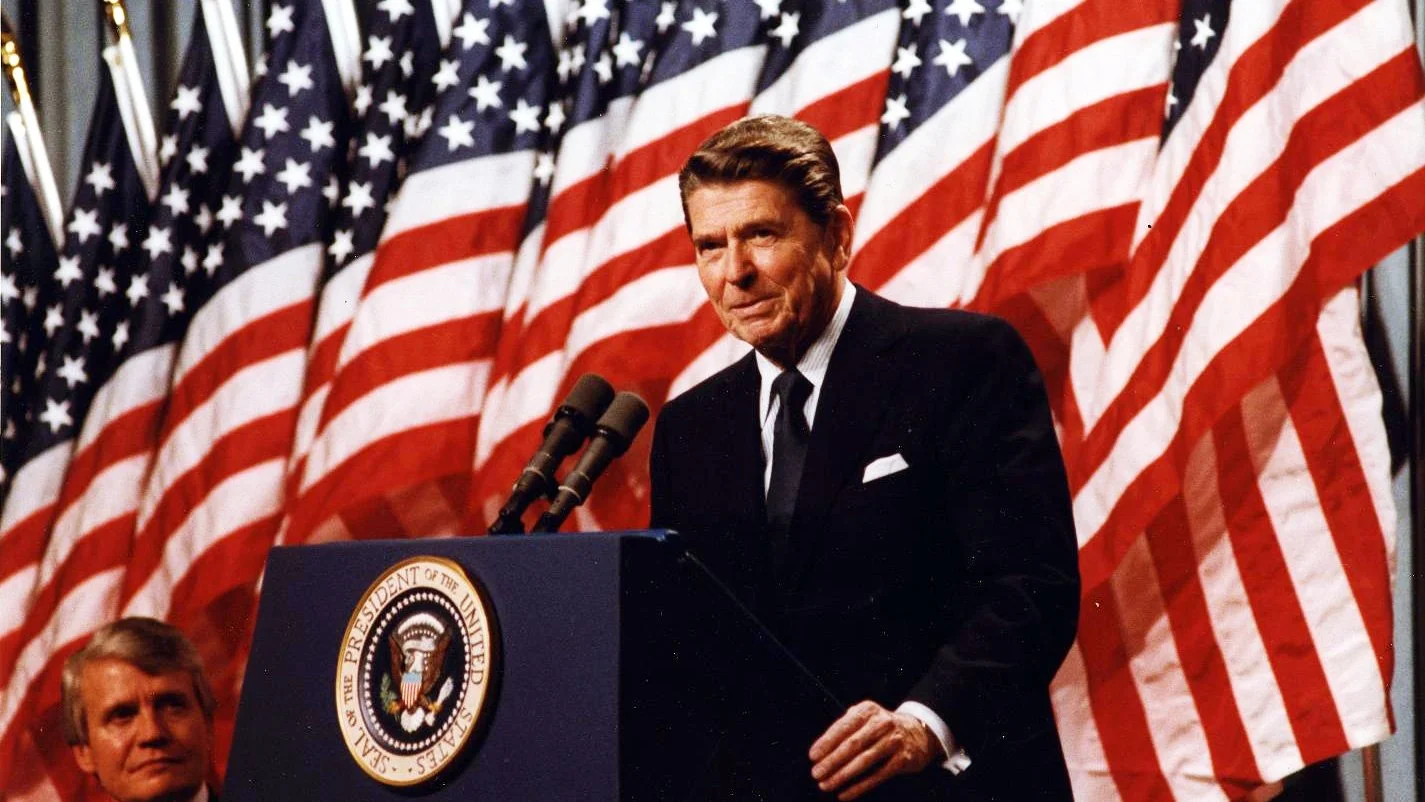
Jefferson's principles are so deeply American and so practical that even leaders from rival political traditions have turned to him for guidance. Just as Abraham Lincoln looked back to Jefferson to steady the nation during its darkest hour, Ronald Reagan leaned on Jefferson's wisdom throughout the 1980s to help lead America toward renewal, freedom, and prosperity, at a time when annual inflation had hit 13.5%, gas prices equaled more than $5 a gallon in today's money, and interest rates had surged past 20%.
To appreciate why Reagan admired Jefferson so much, it helps to look first at Jefferson's own political world. In the early days of our country, Jefferson and his close ally James Madison led the republican movement (written here with a lowercase r, as it was the label used in Jefferson's time and is completely different from the modern-day Republican Party). Their opponents were the federalists, who favored a much stronger central government.
The political battles between the republicans and the federalists were fierce. As Reagan himself noted in a speech at the University of Virginia in December 1988, during the bitter election of 1800, a federalist newspaper in Connecticut warned that if Jefferson won, "Murder, robbery, rape, and adultery and incest will be openly taught and practiced." Yet Jefferson's core beliefs were never meant to belong to just one narrow faction.
In fact, Jefferson and Madison used the name republican not to build a typical political party, but to remind Americans that the United States was an anti-monarchy republic governed by the consent of the people. Their goal was to bring the country back to the supreme law of the land, the Constitution, and to protect its strict limits on federal power. Those ideas were built on common sense and trust in everyday people.
Centuries later, Ronald Reagan stood on the national stage as the leader of the modern Republican Party, a party that traces its roots back to Abraham Lincoln and the old opponents of Jefferson's movement. On paper, Reagan and Jefferson came from different political traditions. In practice, Reagan was a devoted student and admirer of Jefferson.
That admiration was personal as well as political. In an October 1981 speech, Reagan explained what he did whenever he felt worn down by the pressures of office: "Whenever I find my battery is running down, I like to go over to the monument, not so far from here, erected to the memory of that great American patriot who wrote down in immortal words the fundamental faith and philosophy which gave our Nation its birth and its greatness, Thomas Jefferson."
Inside that monument, Reagan looked to Jefferson's own words as a compass for making tough decisions. Reagan pointed to the giant letters carved above the 19-foot statue inside the Jefferson Memorial, where Jefferson declared, "I have sworn upon the altar of God eternal hostility against every form of tyranny over the mind of man." Reagan added, "Now, that, to the best of my ability, has been the basic standard by which I tried to judge which of the various solutions being offered for this, that, or the other difficult problem for our country was right or nearest right."
Putting that Jeffersonian standard into action meant embracing federalism, the constitutional system that divides power between the national government, the states, and local communities. In a July 1982 speech, Reagan read Jefferson's full explanation of how power should be shared: "Were not this great country already divided into states, that division must be made, that each might do for itself what concerns itself directly and what it can do so much better than distant authority. Every state is again divided into counties, each to take care of what lies within its local bounds; each county again into townships or wards to handle minute details. Were we directed from Washington when to sow and when to reap, we should soon want for bread."
For Reagan, that division of power made complete sense because whenever a problem can be handled locally, the fastest and most effective fix is the one closest to that problem. Local leaders and everyday citizens understand their own needs far better than distant officials in Washington. In October 1987, Reagan backed up his push to return power to the states by quoting Jefferson's view that states are "the most competent administrations for our domestic concerns and the surest bulwarks against anti-republican tendencies."
Along with trusting local governments, Reagan shared Jefferson's deep faith in the wisdom of ordinary working people. Speaking in July 1987, Reagan rejected the idea that farming and daily life should be run by politicians or academics, quoting Jefferson's observation: "State a moral case to a ploughman and a professor, and the former will decide it as well, and often better, than the latter, because he has not been led astray by artificial rules." Putting faith in working farmers, families, and small business owners was, to Reagan, the secret to unlocking America's economic strength.
That shared belief in practical limits on power also shaped how Reagan approached government spending and debt. During the 1980s, as Reagan pushed for a balanced budget amendment, he constantly reminded Americans that Jefferson had spotted this exact danger nearly 200 years earlier. In July 1982, Reagan cited Jefferson's warning that "The public debt is the greatest of dangers to be feared," noting that Jefferson "believed that it was wrong and immoral for one generation to forever burden the generations yet to come."
Reagan returned to that same warning whenever Congress debated federal budgets. In March 1985, he quoted Jefferson again: "The principle of spending money to be paid by posterity, under the name of funding, is but swindling futurity on a large scale." Speaking in January 1986, Reagan even joked about what he would do if Congress finally passed an amendment banning the federal government from borrowing money: "And when we get that, I'm going down there to the Jefferson Memorial to see if that statue of Tom is smiling."
Beyond economics and budgets, Jefferson's words guided Reagan in defending human freedom around the world. At a time when the Cold War divided the globe, Reagan drew strength from Jefferson's belief that liberty is a gift from God, not a favor granted by politicians. In a May 1984 speech, Reagan quoted Jefferson directly: "The God who gave us life, gave us liberty at the same time."
That belief in God-given rights fueled Reagan's confidence that democracy would eventually win out over tyranny. Speaking to students at the University of Virginia in December 1988, Reagan noted that "the same idea that so energized Mr. Jefferson and the other founders of this nation, the idea of popular government, has driven the revival of the West and a renewal of its values and its beliefs in itself." In June 1984, Reagan pointed to the global spread of democracy by quoting Jefferson's words: "The mass of mankind has not been born with saddles on their backs."
Of course, Reagan knew that a free society can only survive when citizens stay informed through an uncensored press. In April 1988, he told newspaper editors that "freedom of the press is, and must always be, above politics." To back up his point, Reagan turned once more to Jefferson's promise: "When the press is free and every man able to read, all is safe."
While Jefferson taught Reagan how to defend freedom abroad, he also taught him how to heal divisions at home. Perhaps the greatest lesson Reagan took from Jefferson was about how Americans should treat one another despite their political disagreements. In his July 4, 1986 address, Reagan told the story of Jefferson and John Adams, who had worked closely together for independence before becoming bitter political rivals in the election of 1800. Years later, in retirement, the two old men put aside their anger and began writing warm letters to each other about gardening, family, religion, and their hopes for the nation.
That late-life friendship ended on a remarkable note. Both men died on the exact same day, the Fourth of July in 1826, 50 years to the day after the Declaration of Independence was adopted. Reagan read from one of Jefferson's letters to Adams: "It carries me back to the times when, beset with difficulties and dangers, we were fellow laborers in the same cause, struggling for what is most valuable to man, his right to self-government." Reagan called this "their last gift to us, this lesson in brotherhood, in tolerance for each other, this insight into America's strength as a nation."
Reagan carried that lesson of unity straight into the halls of Congress, echoing the famous words Jefferson spoke in his own first inaugural address after the bitter election of 1800: "We are all republicans, we are all federalists." In an October 1986 speech, Reagan directly borrowed that line, saying, "To paraphrase Mr. Jefferson: We are all Democrats, we are all Republicans, because we are all Americans." He brought that same spirit to his 1988 State of the Union address, declaring, "In the spirit of Jefferson, let us affirm that in this Chamber tonight there are no Republicans, no Democrats, just Americans."
When you look at how deeply Jefferson influenced leaders from across the political spectrum, it is easy to see why he inspires such affection across every generation. As Reagan noted in July 1987, a 33-year-old Jefferson wrote the words that defined our nation. In that same speech, Reagan summed up Jefferson's vision of government with a quote from Jefferson's first inaugural address: "A wise and frugal government, which shall restrain men from injuring one another, which shall leave them otherwise free to regulate their own pursuits of industry and improvement, shall not take from the mouth of labor the bread it has earned." Reagan added simply, "Well, that vision of America still guides our thinking, still represents our ideals."
Because those truths are timeless, leaders from completely different eras and parties like Lincoln and Reagan could both look to Jefferson as a compass. As Reagan put it in July 1987, "We're still Jefferson's children, still believers that freedom is the unalienable right of all of God's children." Thomas Jefferson does not belong to one party or one century. He belongs to every person who believes that ordinary people, left free to dream and work, can build a better future.