Thomas Jefferson's Roots
Just in time for Thanksgiving, looking at Thomas Jefferson's family proves that greatness rarely appears out of thin air. Born on April 13, 1743, at Shadwell along the Rivanna River near Charlottesville in the Virginia province, Thomas was the third of ten children and the oldest son of Peter Jefferson and Jane Randolph.
Thomas was named after his grandfather, Thomas Jefferson the second, and shared that name with his great-grandfather and an uncle who died at 23 years old. Yet the driving force behind his character was his father. Peter Jefferson was a towering giant of deeds, not empty words, proving that Thomas came from unstoppable stock.
Thomas owed his relentless drive and practical genius straight to his father. Born on February 29, 1707, under the Old Style calendar used at the time, or 1708 under the modern calendar, Peter was a semi-self-made man who carved out his place through sheer grit.
As the youngest of three sons, born after his brothers Thomas and Field, Peter was not the heir apparent to his family's estate. His formal schooling was neglected, so he refused to wait for handouts and educated himself. He read Shakespeare and Joseph Addison by candlelight and mastered surveying and mathematics through pure willpower.
Peter backed up that sharp mind with legendary physical power. Local stories claimed he could stand between two massive hogsheads of tobacco lying on their sides, each weighing around 1,000 pounds, and tip both upright at once. Neighbors also told how, when enslaved workers struggled to pull down an old shed with a rope, Peter stepped in and yanked it down alone.
Even if those tales grew taller over time, his real-world endurance conquered some of the deadliest wilderness in Virginia history. Today, the 1,500-foot peak called Peter's Mountain in Albemarle County stands as a permanent monument to his frontier grit.
Peter was at his best when facing the untamed frontier. In 1746, when Thomas was four years old, 39-year-old Peter joined 40 men and 40 horses to survey the Fairfax Line. This 76-mile boundary cut across steep mountain ridges to mark the western edge of Lord Fairfax's land grant. The seven-week trek was brutal. Several horses died, and the rest nearly starved. At the headwaters of the Potomac River, the team finally set the Fairfax Stone, and Peter carved P J into a nearby beech tree.
Three years later, in 1749, Peter teamed up with mathematics professor Joshua Fry, who later served as George Washington's superior officer, to extend the dividing line between Virginia and North Carolina for 90 miles. According to Jefferson family tradition, that trek pushed the men to the absolute limit. They fought wild beasts by day, slept up in trees at night for safety, and ate raw meat when supplies ran out. Impressed by their courage, the colonial council rewarded Fry and Jefferson 300 pounds sterling each above their expenses.
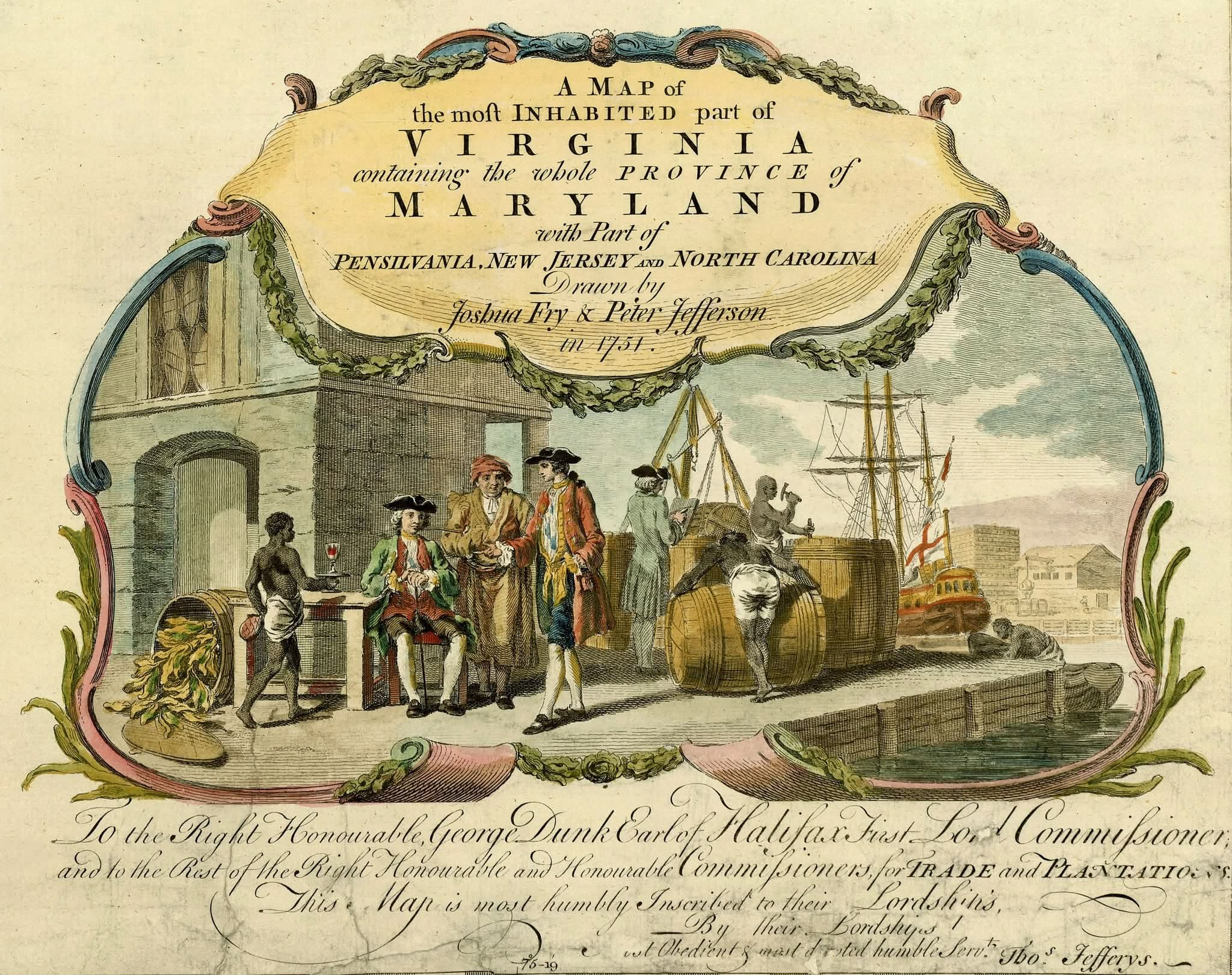
By 1751, Peter's wilderness days ended, yet his bold vision reshaped the map of America. Alongside Fry and other partners, he helped form the Loyal Company of Virginia, securing a massive 800,000-acre grant to open up western lands. Between 1751 and 1753, he and Fry also produced the Fry-Jefferson Map of Virginia. It was the first map to accurately chart the parallel ridges of the Allegheny Mountains, standing as the most trusted map of Virginia for more than 50 years.
Thomas inherited his father's hunger for geography and the outdoors, backed by extraordinary genes from both sides of his family. His paternal great-grandfather, who died in 1697, was a rugged planter, surveyor, and wolf hunter. His grandfather, Thomas Jefferson the second, served as a gentleman justice, militia captain, sheriff, and church builder.
On his mother's side, Thomas drew fierce scientific curiosity from his maternal grandfather, Isham Randolph of Dungeness, who died in 1742. Educated at the College of William and Mary, Isham was a seasoned sea captain, a colonial agent in London, and adjutant general of Virginia. He was also an avid botanist who traded rare American plants with leading European scientists. His tombstone praised him for having the qualities of a gentleman in the most eminent degree, knowing no enemies, and gaining many friends.
At home and in his community, Peter modeled the fearless leadership and hospitality that later defined his son. Starting in the 1730s, he served as a justice of the peace, sheriff of Goochland County, and county surveyor, much like George Washington. When Albemarle County formed in 1744, he became a founding magistrate, a lieutenant colonel of the militia, and later a representative in the House of Burgesses in 1754 and 1755.
Peter's door was open to everyone, including Native American leaders traveling to Williamsburg. One honored guest at Shadwell was the prominent Cherokee leader and orator Ostenaco, known by his war title Outassete. Young Thomas sat beside his father listening to Ostenaco's commanding speeches around the fire, an experience that sparked his lifelong admiration and respect for Native Americans and their cultures.
People trusted Peter because his word was iron. When his close friend William Randolph of Tuckahoe died in 1745, Randolph named Peter guardian of his young son. Peter honored that promise immediately, moving his family to Tuckahoe from 1745 to 1752 to manage the estate. Afterward, they returned to Shadwell, the home Peter had built on 400 acres bought from William Randolph, paying cash for half and trading Henry Weatherbourne's biggest bowl of arrack punch for the other 200 acres.
Sadly, Peter died before reaching 50 years old, passing away on August 17, 1757, during a widespread malady. He left behind a lanky 14-year-old Thomas, yet he had already built a powerhouse legacy for his family. His estate included over 7,200 acres, more than 60 enslaved workers, 25 horses, 70 cattle, and 200 hogs. Along with the Rivanna River land where Thomas would later build Monticello, Peter left his son his surveying tools, his desk, and his prized library of about 40 volumes and maps, which tragically burned in a house fire at Shadwell in 1770.
More than land or books, Peter's greatest gift as a father was demanding the formal education he had been denied. On his deathbed, he ordered that Thomas receive a thorough classical education so his mind could reach its full potential.
Decades later, Thomas wrote that he felt more indebted to his father for that classical schooling than for any other luxury placed within his reach, saying he thanked him on his knees for such a rich source of delight. Through powerhouse genes, relentless grit, and fierce devotion, Peter Jefferson forged the foundation for the Thomas Jefferson America remembers today.