
Jefferson in Paris: Great for Hollywood, not for history
Today, movies, documentaries, and even Monticello repeat the story that Thomas Jefferson had a secret romance with Sally Hemings in Paris. Yet when you look closely at the actual historical record, that famous story rests on shaky secondhand claims, not solid proof.
The entire Paris romance tale comes from a single article printed in a small partisan Ohio newspaper, the Pike County Republican, in 1873, nearly 50 years after Jefferson died. That article claimed to tell the life story of Sally's son, Madison Hemings, who grew up enslaved at Monticello and later moved to Ohio. However, Madison did not even write the piece himself. Instead, it was written entirely by the paper's editor, Samuel F. Wetmore, a fierce abolitionist and partisan activist who hated Southern plantation owners and slaveholders and used the story to attack the Southern elite. Wetmore put his own words to an interview where Madison repeated rumors he had only heard secondhand about events in France that happened 16 years before he was even born.
Even the setting of Paris makes the story hard to believe. In the late 1780s, Paris was packed with royal spies and secret police who closely watched foreign diplomats, opened mail, and wrote down every rumor or scandal they could find. If an American minister had been carrying on a secret affair with a teenage servant, French spies would have recorded every detail. Yet modern researchers digging through those surviving French police archives have come up with nothing at all.
What the historical record actually shows is that Jefferson's romantic focus in Paris was on a completely different woman: Maria Cosway. Born in Italy to English parents, Maria was a brilliant, sophisticated painter, musician, and composer who spoke multiple languages and moved easily through Europe's highest intellectual circles. Jefferson was deeply infatuated with her, famously writing his emotional Head and Heart letter to her in 1786. Comparing Maria Cosway to young Sally Hemings, an uneducated, childish teenage servant who couldn't even read or write, shows the exact kind of cultured, intellectual equal that truly drew Jefferson's affection.
Before that 1873 article, the rumor was started in 1802 by James Callender, a bitter political writer who turned on Jefferson after being denied a government job. Callender couldn't even get the basic facts right, claiming Sally went to France with Jefferson when she actually arrived three years later in 1787 as a maid for his young daughter Maria.
Callender also claimed in his 1802 articles that Sally had a 10 or 12-year-old son named Tom, later known as Thomas Woodson, whom Callender insisted was fathered by Jefferson, placing his conception right in Paris just before they returned home. For generations, writers repeated Callender's claim about Tom as proof of a Paris affair. Yet in 1998, a major DNA test proved Thomas Woodson had zero Jefferson blood in him at all, showing how Callender's centerpiece story was false and how fast people jump to conclusions just because a boy was named after Jefferson.
The people who actually lived with Jefferson and knew him best flatly rejected the rumor. His own daughter Martha, who knew his daily habits inside out, insisted on her deathbed that the story was a lie. Longtime overseer Edmund Bacon also denied it, stating he personally saw another man leaving Sally's quarters early in the morning.
Jefferson's oldest grandson, Thomas Jefferson Randolph, who ran the estate and knew everything happening behind the scenes at Monticello, positively declared the rumor false and pointed to other male relatives instead. His granddaughter, Ellen Randolph Coolidge, wrote in an 1858 letter that the family met the charges with horror and contempt, noting that no female servant ever entered Jefferson's private rooms while he was there.
Former Monticello slave Isaac Granger Jefferson left detailed memories of life on the mountain without ever claiming Thomas fathered Sally's children, pointing instead to Jefferson's younger brother Randolph, who loved visiting the slave quarters at night to play his fiddle. Even outside Monticello, Abigail Adams described young Sally in London as a childish girl who acted more like a seven-year-old, while John Adams dismissed Callender's gossip as the lies of a desperate slanderer.
Best of all, Jefferson refuted these attacks himself in private letters to close friends. On October 10, 1802, just weeks after Callender printed his smear, Jefferson wrote to his friend Robert R. Livingston in Paris, calling Callender a lying renegado and noting that every decent man revolted at his filth.
Then, on July 1, 1805, Jefferson wrote privately to Secretary of the Navy Robert Smith and Attorney General Levi Lincoln to set the record straight with his closest allies. He owned up to a single youthful mistake involving a friend's wife decades earlier and stated flatly that it was the only one founded in truth among all the charges against him, ruling out the Sally Hemings rumor completely.
When modern critics ignore these firsthand witnesses and force a sensational romance onto Jefferson's life, they miss who he really was. Jefferson was a rare outlier, a deeply disciplined genius whose mind worked nothing like ordinary people. Trying to judge a man of his stature through modern gossip says far more about the minds of his critics than it ever will about Thomas Jefferson.
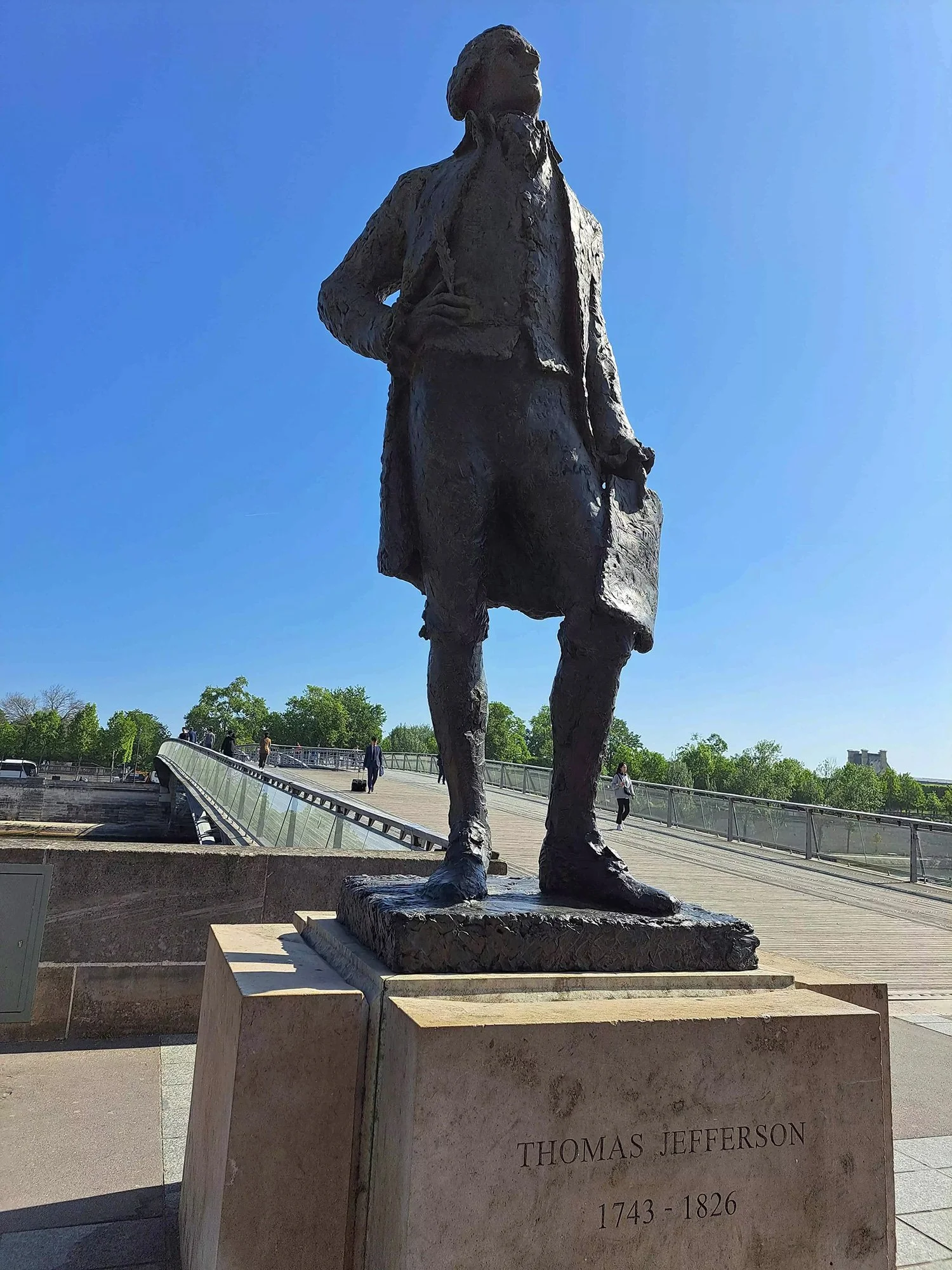
Thomas Jefferson statue in Paris