Jefferson: intelligent, introvert, rebel
Thomas Jefferson was a major political radical, way more than most people realize today. He was famous for his quiet, introverted personality, but underneath that shy exterior was a revolutionary mind that flipped the whole idea of government on its head. He truly believed that governments only exist to serve the people, and if a government turns into a bully, the people have a moral duty to tear it down.
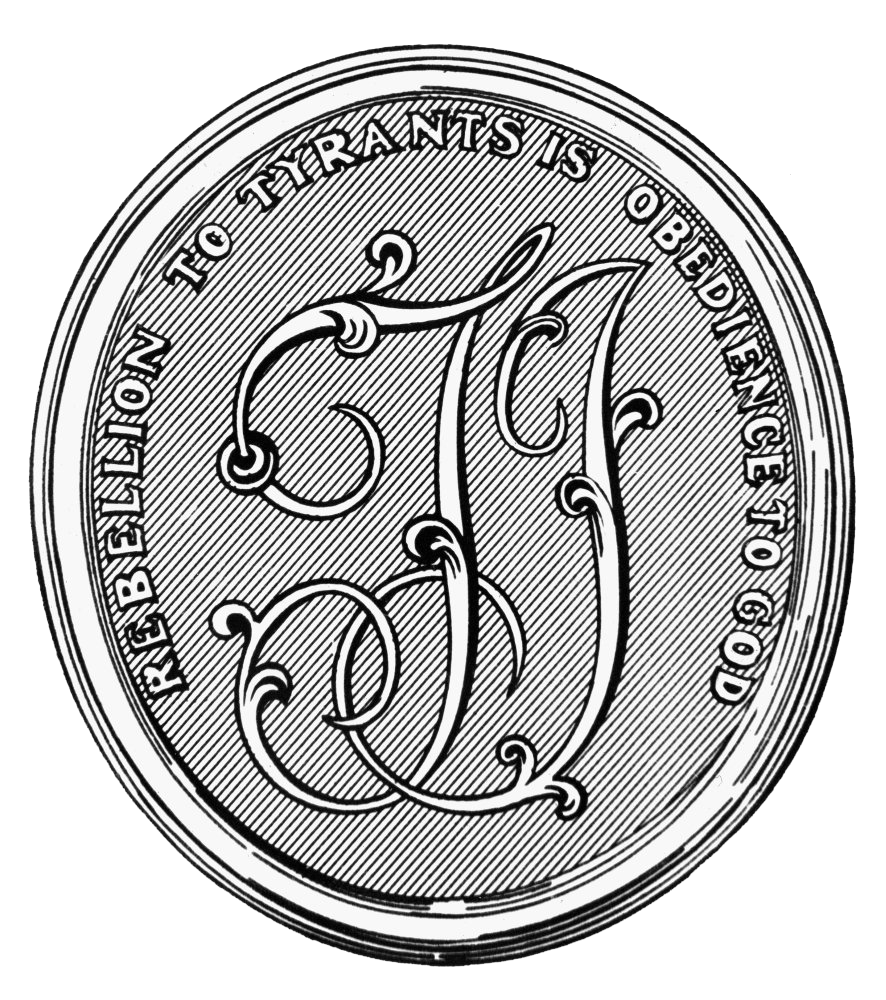
This deep belief is perfectly captured in his favorite motto: "Rebellion to tyrants is obedience to God." This phrase turned revolution from a dangerous political risk into a spiritual duty. While a lot of people think Jefferson came up with it himself, it actually came from Benjamin Franklin. In August 1776, right after the Declaration of Independence was signed, Congress asked Jefferson, Franklin, and John Adams to design the Great Seal of the United States. Franklin suggested a drawing of Moses parting the Red Sea to drown Pharaoh's army, with those exact words wrapping around the edge. Congress didn't pick that design, but Jefferson loved the phrase so much that he adopted it as his official personal motto and seal. He stamped it on his letters and even had it put on the iron gates of his family graveyard at Monticello. To Jefferson, fighting back against an abusive ruler wasn't just a legal right; it was a responsibility given by God.
So how did a quiet, awkward kid from rural Virginia grow up to think this way? It all started when he went to college. In 1760, at just 16 years old, Jefferson started studying at the College of William and Mary. His life-changing mentor there was Dr. William Small, a mathematics professor from Scotland. Small was a total rebel in the academic world. Instead of making students memorize boring religious texts, he used the Socratic method, pushing them to think for themselves through lively debates. Small introduced Jefferson to cutting edge thinkers like John Locke and Isaac Newton, who argued that the world runs on natural laws, not the random whims of kings. Jefferson later said that Small completely shaped the destiny of his life.
Dr. Small then introduced Jefferson to George Wythe, the man who would teach him law starting in 1762. Wythe was another incredibly radical thinker for his time. During the Stamp Act crisis of 1765, Wythe wrote a fierce protest to the British parliament against unfair taxes. Even though Wythe was normally a gentle, quiet person, he had zero tolerance for British overreach. He drilled the concept of natural human rights into Jefferson's head, teaching him that our freedoms come from nature, not from a king's permission. On top of that, in a world that completely relied on slavery, Wythe hated the practice. He eventually freed the people he enslaved, and later on as a high ranking judge, he even ruled that Virginia's laws meant Black Americans were naturally free unless someone could prove otherwise. Wythe showed the introverted Jefferson that a quiet, dignified man could use the law as a powerful weapon to change the world.
Jefferson also got his radical ideas from some pretty unusual places. He was obsessed with early medieval English history and loved the old Anglo-Saxons. He believed that back before the Norman Conquest of 1066, regular English people lived in perfect, free communities. He looked at the American Revolution as a way to win back that ancient freedom. He was also radically ahead of his time when it came to freedom of religion. Back then, everyone in Virginia was forced by law to pay taxes to support the Church of England. Jefferson fought hard to change this, arguing that forcing someone to fund a religion they don't believe in is a total violation of their basic rights.
When he finally became president in 1801, Jefferson took his radical, anti-royal beliefs and brought them straight into the White House. He completely threw out the stuffy, king-like formalities that George Washington and John Adams had used. It all started on his inauguration day on March 4, 1801. Instead of riding in a fancy, royal-looking carriage pulled by six horses, Jefferson simply walked to the Capitol building through the muddy streets like a regular citizen. Once in office, he got rid of formal, assigned seating at state dinners, using a "pell-mell" policy where anyone could sit anywhere. He shocked visiting foreign diplomats by greeting them in everyday, comfortable clothes, often wearing an old coat and yarn slippers down at the heels. To Jefferson, a president was just a regular citizen hired to do a job, not a king to be worshiped.
This radical streak is exactly why modern Americans should look up to Jefferson. He wasn't a typical politician trying to play it safe. He was a visionary who believed that every new generation has the right, and the duty, to rewrite the rules of government. In a famous letter from 1787, he even said that a little rebellion now and then is a good thing, because it keeps the government healthy. For Americans today, Jefferson's journey from a shy student to a bold defender of freedom is an inspiring reminder. True patriotism doesn't mean doing whatever the government tells you to do. It means having the guts to stand up to power, remembering that our rights belong to us naturally and can never be taken away.