Jefferson's federalism dilemma in his letter to Holmes
While Thomas Jefferson’s April 22, 1820 correspondence to John Holmes exposes deep anxieties regarding the future of the American republic, its underlying political logic remains bound to his strict view of American federalism. As established in our prior discussion regarding Jefferson's moral and legal paradoxes, the aging statesman was fully capable of recognizing severe ethical contradictions on paper while remaining entirely trapped by them in practice. This same internal friction extended directly into his political philosophy. By definition, federalism is a system of government where power is constitutionally divided and shared between a central national authority and individual state or regional governments. In the American context, this structure splits responsibilities so that the national government manages broad external affairs like foreign policy and national defense, while individual state governments retain sovereignty over their localized, domestic policies. In his letter, Jefferson’s horror was fundamentally driven by the fear that drawing a hard line over domestic policy would permanently fracture the Union. Yet, his solution relied entirely on a strict-constructionist framework of federalism, asserting that regulating the condition of people within a state belonged exclusively to the states themselves. Jefferson captured the terrifying magnitude of this sectional crisis by writing:
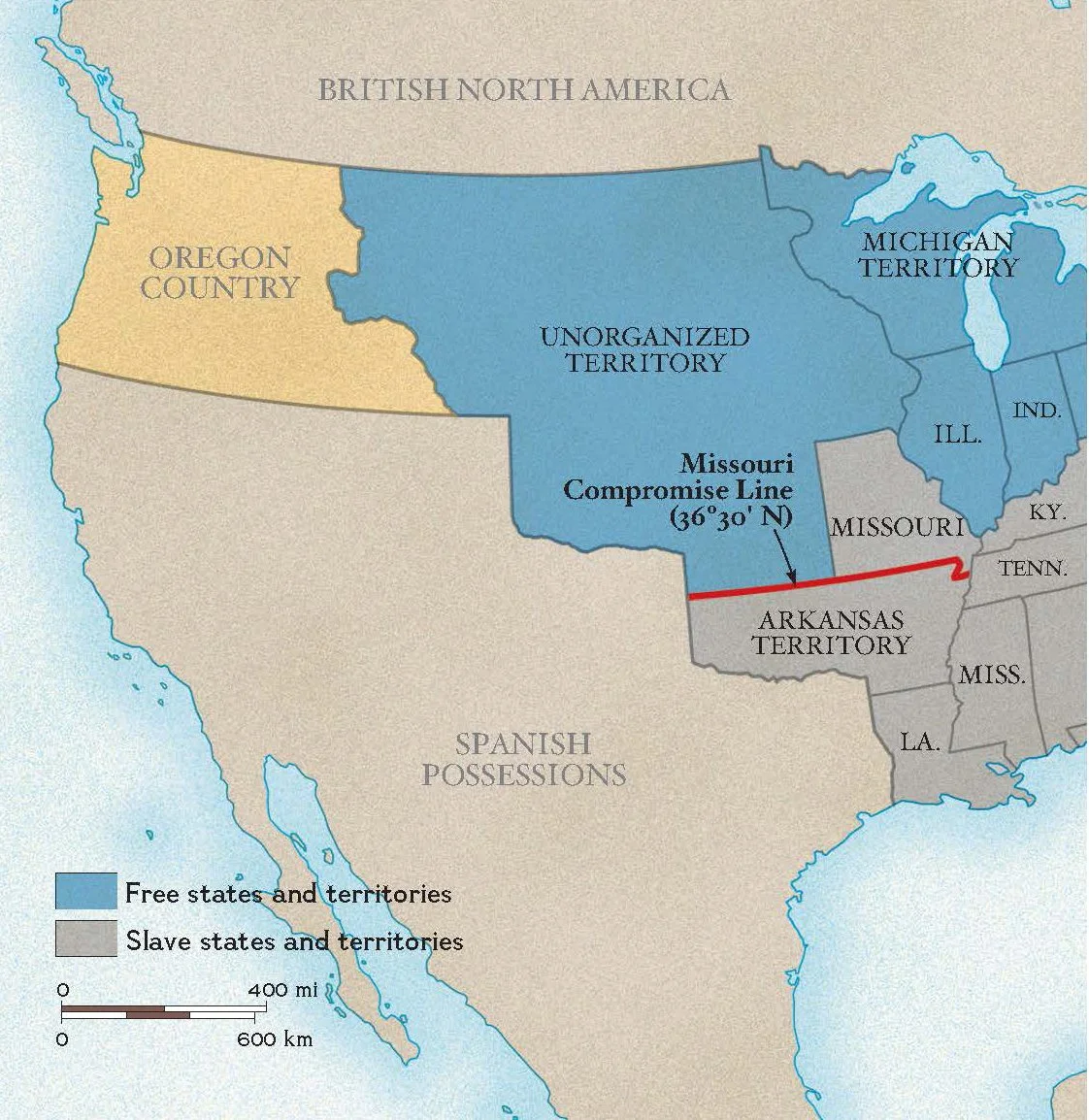
"but this momentous question, like a fire bell in the night, awakened and filled me with terror. I considered it at once as the knell of the Union. it is hushed indeed for the moment. but this is a reprieve only, not a final sentence. a geographical line, coinciding with a marked principle, moral and political, once conceived and held up to the angry passions of men, will never be obliterated; and every new irritation will mark it deeper and deeper."
This deep devotion to state autonomy over domestic issues was forged decades earlier in the fierce political battles of the early republic. During the Adams administration, the passage of the Alien and Sedition Acts signaled to Jefferson that the central government was prepared to violate the constitutional boundaries of its authority. In response, he secretly drafted the Kentucky Resolutions of 1798, which introduced the radical doctrine that states, as the original parties to the constitutional compact, retained the ultimate authority to judge federal overreach. While the Kentucky legislature removed Jefferson’s explicit phrasing of nullification as "the rightful remedy" from the version it actually adopted in 1798, his foundational theory that the true checks and balances of the American system existed between the national capital and the state capitals remained central to his political legacy.
The controversy surrounding Missouri brought these long-standing structural debates to a volatile boiling point. The crisis did not involve the federal government simply dictating terms to an already-sovereign existing state, but rather a fierce constitutional dispute over whether Congress had the authority to attach anti-slavery conditions to a territory applying for new-state entry. For Jefferson, allowing the central government to condition statehood on the regulation of its internal domestic affairs was a dangerous expansion of federal power. He argued that the right to regulate the status of individuals was an exclusive prerogative retained by the states. While his primary alarm in the letter was not an abstract conspiracy about Northern federalists subjugating the South, but rather the terror of a permanent "geographical line" fracturing the nation, his defense of Missouri’s entry without restrictions was firmly rooted in preserving the original constitutional balance of state control.
Ultimately, Jefferson’s philosophy of federalism in the Holmes letter revealed a tragic paradox between regional autonomy and national survival. His letter was less an abstract federalism manifesto and more a desperate warning about the fragility of the Union when moral principles collided with geographic boundaries. By prioritizing the absolute independence of states to settle their own domestic matters over a coordinated national solution, Jefferson championed a decentralized framework that sought to protect local self-governance, but left the country structurally unequipped to peacefully resolve its greatest moral crisis.
In essence, Jefferson saw the Union was heading toward disaster, similar to his personal fiscal disaster. Both involve the issue with slavery and both offer no viable solution.
Read about the other tragic revelations of Jefferson’s letter to Holmes: https://www.thomasjefferson.com/jefferson-blog/tragic-revelations-of-jeffersons-letter-to-holmes