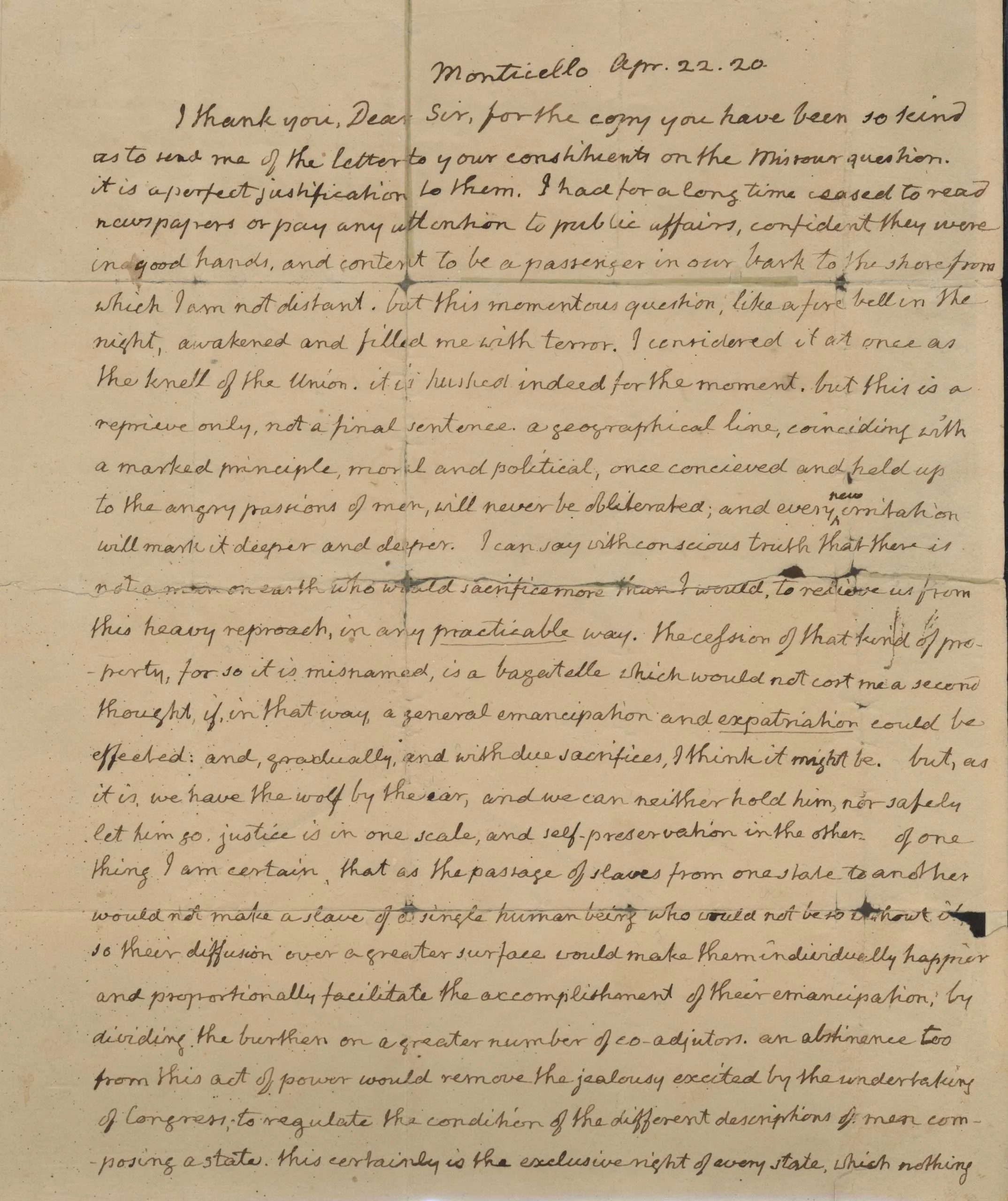
Tragic revelations of Jefferson's letter to Holmes
In his famous April 22, 1820 letter to John Holmes regarding the Missouri Compromise, Thomas Jefferson made a striking linguistic admission: he explicitly stated that calling enslaved people "property" was a factual inaccuracy. To ensure the reader fully understands that the subject of this discussion is the enslaved population, the quotation must be read in its complete context. While discussing the immense personal and financial sacrifices required to rid the nation of the institution, Jefferson wrote:
"I can say with conscious truth that there is not a man on earth who would sacrifice more than I would, to relieve us from this heavy reproach, in any practicable way. the cession of that kind of property, for so it is misnamed, is a bagatelle which would not cost me a second thought, if, in that way, a general emancipation and expatriation could be effected: but, as it is, we have the wolf by the ear, and we can neither hold him, nor safely let him go. justice is in one scale, and self-preservation in the other."
By explicitly pairing the phrase "that kind of property" with the goal of "a general emancipation and expatriation," Jefferson leaves absolutely no room for ambiguity: the property he is referring to is the millions of human beings held in American bondage. Furthermore, by utilizing the parenthetical phrase "for so it is misnamed," Jefferson conceded a profound philosophical truth. As an Enlightenment thinker and the primary author of the Declaration of Independence, he understood that natural rights belonged to all mankind. He recognized the humanity of the enslaved population, choosing his words carefully to indicate that while the laws of the American South legally treated them as objects, moral reality did not.
However, this intellectual clarity stood in sharp contrast to the brutal financial and legal entrapment of Jefferson’s personal life, as well as the deep-seated fears that gripped the Southern elite. When Jefferson famously lamented that the nation held a wolf by the ear, his terror of letting that wolf go was rooted in real-world history. White southern enslavers were deeply terrified by the successful, violent slave uprising of the Haitian Revolution, which proved that an enslaved population could successfully overthrow their oppressors. This fear hit incredibly close to home for Jefferson in 1800, during the final months of his presidential campaign. In Richmond, a literate, enslaved blacksmith named Gabriel organized a massive, highly sophisticated plot to recruit hundreds of enslaved people, march on the capital, seize the state armory, and take Virginia Governor James Monroe hostage to force the emancipation of Virginia's slaves. Though Gabriel’s Conspiracy was ultimately thwarted by a massive torrential rainstorm and betrayal by informants, the event permanently shattered any illusions of a passive enslaved workforce. Gabriel’s rebellion, directly inspired by the ideals of the Haitian and American Revolutions, proved to Jefferson and Monroe that keeping millions in bondage was an active security threat, yet freeing them without immediate total colonization ("expatriation") could spark an apocalyptic race war.
This political panic was compounded by the consequences of Jefferson’s own public career and personal insolvency. Jefferson entered public service a wealthy young planter, but he retired completely buried under an economic cataclysm. Jefferson was an honest, non-corrupt public servant who never used his political offices for personal enrichment; as he famously observed, his hands were "as clean as they are empty." Yet, four decades of serving the young republic as Governor, Minister to France, Secretary of State, Vice President, and President came at an immense personal cost. Early American statesmen received no pensions, and Jefferson was forced to pay out-of-pocket for White House operations, private secretaries, and the essential expenses of statecraft. This included acquiring extensive libraries of books to build his own knowledge for the young country's governance, as well as funding the lavish diplomatic entertainment and fine wines required to properly host foreign dignitaries for America's international benefit. Because he was away serving his country for decades, his lengthy absence left his personal agricultural estates neglected and unprofitable.
This financial sacrifice, compounded by inherited liabilities from his father-in-law, ultimately led to his total insolvency. By 1820, Jefferson was hopelessly in debt, culminating in a financial ruin that directly impacted his legal status as a slaveholder. Under Virginia law, enslaved laborers were classified as legal assets and served as collateral for compounding debts. Because his estate was heavily leveraged, Jefferson did not legally have the freedom to simply emancipate the people at Monticello. His creditors held the ultimate financial liens on his property, and freeing them would have been a fraudulent dissolution of his security. The very system Jefferson loathed legally trapped him, linking his personal financial ruin and the nation's political terror to the permanent bondage of those he enslaved.
Ultimately, his letter to Holmes proves that Jefferson was fully aware of the moral illegitimacy of slavery, explicitly identifying the term "property" as a legal fiction. Yet, his situation perfectly illustrated the tragedy of his legacy: an honest statesman who bankrupted himself in service to American liberty, paralyzed by the economic traps of debt law and the haunting specter of Gabriel’s rebellion, leaving him legally and politically powerless to dismantle the very misnomer of human property he exposed on paper.
Also, read about the federalism dilemma of this Holmes letter: https://www.thomasjefferson.com/jefferson-blog/jeffersons-federalism-dilemma-in-his-letter-to-holmes