When Theodore Roosevelt changed his mind about me
Every president of the United States, past and present, has praised my vision for American democracy and the Declaration of Independence. However, this high regard was not always universal. Theodore Roosevelt started out as one of my harshest critics, though a famous historian eventually helped him change his mind.
Below are the details of how that shift happened.
As a young historian in the late nineteenth century, Roosevelt strongly favored a powerful central government and a dominant military. Because I advocated for states' rights, a limited federal government, and an agrarian society, he viewed my philosophy as weak and dangerous for the future of the nation.
In 1896, Roosevelt published the fourth volume of his history book series, The Winning of the West. In it, he attacked my presidency, claiming my policies hindered western growth and left the military neglected. He painted me as a deeply flawed leader who lacked national strength.
The turning point came when Frederick Jackson Turner, the most influential historical theorist of the era, reviewed the book. Turner argued that the democratic spirit of the American frontier actually mirrored my philosophy. He firmly corrected Roosevelt for being overly biased and unfair to my legacy.
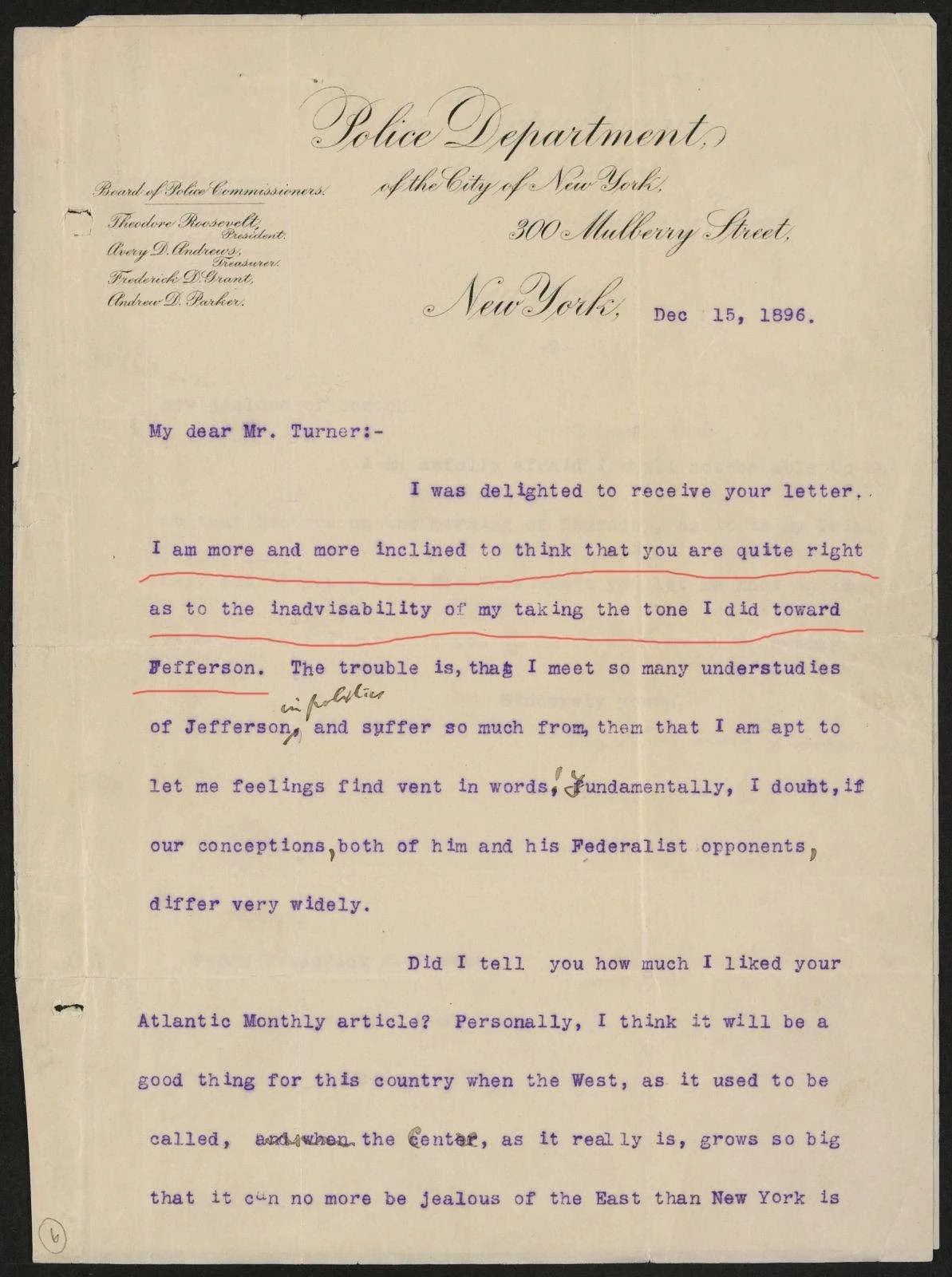
Roosevelt showed true humility and accepted the critique. On December 15, 1896, while serving as the New York City Police Commissioner, he wrote a letter to Turner (shown in photo) admitting that the historian was completely right.
Roosevelt explained that his historical judgment had been clouded by modern politics. He was constantly fighting with contemporary New York politicians whom he despised, viewing them as bad understudies of Jefferson. He confessed that his real-world frustration with these living rivals caused him to vent his anger against me in his writing. Thanks to Turner's guidance, Roosevelt corrected his perspective and joined the rest of America's presidents in respecting my place in history.